Monday, 22 February 2016

The best Old Ale in Britain

CAMRA move in mysterious ways, and I've never been certain how their competitions work. I think it's something like: win at local festival → regional competition → national competition. They seem to deliberately keep it hush-hush though. I know a brewer that had got through to the final of the Champion Beer of Britain competition who was only told off the record. On the plus side unlike the host of competitions you can pay to enter CAMRA actually buy the beer off you!

Back in early December I got a text off a friend at the Pig's Ear beer festival to tell me that Old Dairy Brewery Snow Top had won the London and South competition. Though I no longer work there I keep an interest in how my babies are getting on, and I passed the news on to the current head brewer. This was the first he'd heard of it, but he must have been kept informed of developments as he let me know at the start of this month that Snow Top was in the final at the National Winter Ale Festival. He didn't actually know when the result would be announced mind, but we figured as the CBoB is announced on the trade day it would be then, so that's when he booked his accommodation for.

I was tempted to head up myself but since I've been struck down with senile lightweightism I try and avoid mid-week CPD. I then forgot when the competition was, but when I saw tweets start about the competition I think it's fair to say my interest was rekindled, and I kept an eye on them throughout the day. When the result was announced I saw Snow Top didn't place so "bollocks to that" I thought and shortly after went home.

When I looked at twitter again on my arrival I saw there was rather more to it though. It might not have placed in the top three, but it won its category. The best in the Old Ale and Strong Mild category is a lot better than nothing and I have to say I'm rather chuffed.

The beer is the second version of Snow Top we did. The first did all that fruit and spices rubbish which, lets face it, doesn't really work. So the second time round I ditched all that and just aimed for a classic Winter warmer: dark malt, No. 3 invert sugar and English hops. I think it's a much better beer for it, and I'm glad to see others agree.


The best Old Ale in Britain
Well done to Glenn at the Old Dairy for doing such a good job of making it.

Wednesday, 17 February 2016

Warminster maltings

I was lucky enough to visit Warminster maltings last week. There was only time for the briefest of tours but it's a fantastic looking place.


It was built in1855 by local brewer and maltster William Morgan and remodelled in 1879 by his son Frank.


This was the year before the Free Mash Tun act moved taxation from malt to beer, so to this day the windows are still fitted with Customs and Excise approved bars, put in place to stop unscrupulous maltsters chucking grain out the windows when they saw the tax man coming.


Morgan family member E S Beaven seems to have been the E S Salmon of barley, as he bred the variety Plumage-Archer, which was a dominant variety in Britain until the 1950s. After Beaven's death Guinness bought the maltings, and when they wanted to close it in 1994 the head maltster Chris Garratt took it over, and the head brewer at Guinness's Park Royal brewery helped the new venture by giving them a contract for malt.The need for more funding lead to grain merchant Robin Appel taking over in 2001 and he has continued to invest in the company to this day.

There are several malting floors, where the germination takes place, on two levels.


Floor malting is very labour intensive, and before the grain even gets to the floor it has to be shovelled from the steep tank by to an auger by hand.


Don't know how much effort the kiling involves, but I suspect it's still considerably more than in a modern pneumatic maltings.

As we only had time to rush round I didn't take any notes so I really need to go back for a more leisurely visit. 


Friday, 5 February 2016

SA malt

What is this SA malt?

South African? No

Strasserite? No

Strong or Stock Ale? Could be!

To answer this vexing question I turned once more to the JIB archive, searched for "stock ale malt", and sure enough I got a hit*. There's not a huge amount on it but this table of cost of malt per pound of extract is clear on the name:

Cost per lb. of extract.
d.
English pale ale malt
4.8
English stock ale malt
4.7
English mild ale malt
4.5

So it's clear 'SA malt' stands for 'stock ale malt'. But that's not the end of the story. Oh no! I also did a search for 'strong ale malt', and that also got a hit**.

In describing some of his research Morris says:

"An English strong ale malt was taken, and a normal cold-water extract (100 grams malt to 250 c.c. water) made from it by digestion for three hours with constant stirring."

His work was still incomplete but he does shed some light on the nature of the malt:

"Now, before passing to the other constituents of beer, as shown by this method of analysis, a few words may be said on the practical value of the determination of these low type maltodextrins. It is very evident from what I have said that this constituent is fermentable without very great difficulty, and in this fairly ready fermentability lies a great danger. On the one hand, we require sufficient of this constituent in running and semi-stock ales to give an early after-fermentation, whilst, on the other hand, we have to guard against an excess, which would result in "fretting." In the summer, the highest permissible amount in beers of the above mentioned classes is 5 per cent, of the total wort-solids, and even this amount is liable, when combined with other influences, to give trouble. During the winter, the percentage may rise above 5 per cent, without trouble resulting, but even then it is not desirable to greatly exceed this amount. In stock ales it will usually be found that the percentage falls considerably below this standard, but this is of little importance since, before the beer is required to be sent out other influences, promoting secondary fermentation, come into play."

Speaking of unfermentable material he adds:

"That it was a product of the malting process was shown by the fact that it varied with different classes of malt and in the beers produced from them: badly modified and low-dried malts yielding comparatively little of it, well-modified and high-dried malts giving considerably above the average. Thus, in a Pilsener lager beer only 2.3 per cent, was found, whilst in a Burton strong ale this residue amounted to over 8 per cent, of the total wort-solids."

So SA malt was called both 'strong ale malt' and 'stock ale malt'. I suspect it was almost universally known by the initials, so no one was really certain what they stood for. The malt was less ecomomical to use than mild ale malt, but more economical than English pale ale malt. And it led to beers with a low degree of fermentability.


* The Analytical Control of Certain Brewing Materials. Baker, J.L. and Hulton, H.F. Journal of the Institute of Brewing, 1907.

**  The Analysis of Beer, with some Remarks on the Unfermentable Reducing Residue. Morris, G.M. Journal of the Institute of Brewing, 1894.

Tuesday, 2 February 2016

Another reinheitsgebot loophole

Not being a German brewer I'm not entirely certain what their 'beer purity law', the reinheitsgebot, is. Though it's usually given as 'only water, barley, hops and yeast can be used to make beer' it's considerably more complicated than that. Other grains, and some reason sugar, are allowed in top fermented beers for example.

I fact I do have suspicions that a lot of German brewing practice is designed to drive a cart horse over the spirit of the law whilst staying exactly within the letter of it.  An article in a recent Brauwelt highlights the various possibilities that exist for variety whilst staying within the law. An interesting one I hadn't heard of has been translated as follows:
"reviving historic beer styles which were customarily brewed in certain parts of Germany before the Purity Law came into force in those areas and for which the legal status of traditional speciality beers, exempted from the obligation to comply with the Purity Law by a provision of the current German brewing industry regulating legislation, can therefore be claimed" 
It seems there are exemptions for historic local specialities. So surely it's time for German brewers to study some of Ron's works.

Thursday, 28 January 2016

Tasting panels

I their weekly roundup Boak and Bailey had a link to a post about tasting panels with a very interesting introduction:
"trained tasters are no more likely to be accurate in a triangle test — spotting the odd one out among three beers — than anyone else"
I know from being on the tasting panel at work at there's more to it than the training. So I had a quick word with someone from our sensory department and here's the basics of how you get on the tasting panel for doing triangle tests:

  • First screening: you're given couple of easy triangle tests to carry out to make sure you have a sense of taste.
  • For Quality Assurance compliance you're then given 15 triangle tests and must score at least 60%.

  • Once on the panel scores are monitored and if you drop below 50% you're dropped from the panel.
Training for beer profiling (i.e. scoring beer for different attributes) is something else, and perhaps more like the training that the trained tasters in the original post had received.


Tuesday, 26 January 2016

A win for wild hop

I was delighted to see that the Sussex hop was chosen as the overall winner of the British Hop Awards. In my previous job we were the first brewery to use it, which may even make us innovative. That's right, in brewing you can be innovative by doing everything exactly as you normally do, but using a new hop variety. Harvey's later used Sussex hop in a beer they also named Wild Hop, which did lead Miles Jenner to phone us and check this didn't cause any problems, but we told him not to worry.

The Sussex hop was first grown by Peter Cyster, a retired hop farmer, propagated from a wild hop he liked the look of. Oil analysis has shown it's a new variety, and if I remember rightly it was suspected it was a daugher of Boadicea as it's a also a dwarf variety, and Boadicea is grown on the hop farm where it was found.

I visited the farm back in 2011, when Sussex was grown in one corner. I was surprised to see that the winning hops were grown by A H Hoad and Son, but they've now been growing Sussex for two years so production of the variety is spreading. I have a slight edge on them as Peter Cyster was kind enough to give us some plants at the brewery and I've been growning a Sussex since 2012. I don't think mine will be winning any prizes though, but it goes well in my annual green hop beer.

Sussex hop


Saturday, 23 January 2016

The Bermondsey Beer Mile

Long after it was discovered by the riff-raff I finally went on the Bermondsey Beer Mile. Of course there's no Kernel now, but I'd been to that one before so I was ahead of the game with that.

As is often the case with route finding it was the start that was the most difficult part, but after some aimless wandering we finally found Four Pure at the back of an industrial estate.

William Morris would be proud

There's clearly money behind this outfit as they had a lot of impressive looking shiny things.


The facilities for punters were basic but the place was still busy.


As it was the start of a marathon I went for the weaker end and started on a Session IPA. There were a lot of hops there but some of them were oxidised so a noticeable cheesiness came through. With lots more beer to come I decided not to finish this one, which did lead to the idea of using a scientific system for scoring the breweries. As with pubs, it would be a binary system, with 1 for if the beer was finished, and 0 if it wasn't.

 The next stop on the crawl was Partizan, an interesting name.


Sadly there were no tachankas parked outside and they didn't even have Bella ciao on the stereo.


It would seem they're partizans of the petite bourgeoisie:


Very petite in fact, as the place was small with old looking kit. They definitely haven't got the funding of Four Pure. 

Of the beers they had on one was a Brettanomyces Apricot IPA. I know what you're thinking - sounds like a horrible mess doesn't it? Being a pioneer of the Brettanomyces revival I had to try it though.

The bizarre mix didn't have the effect I was expecting, as I couldn't pick out any Brett, apricot, or indeed new world hops. It just tasted horrible. The fact it was a proper opaque London Murky might well have been the reason, but anyway it was a resounding 0 for Partizan.

#murkshaming

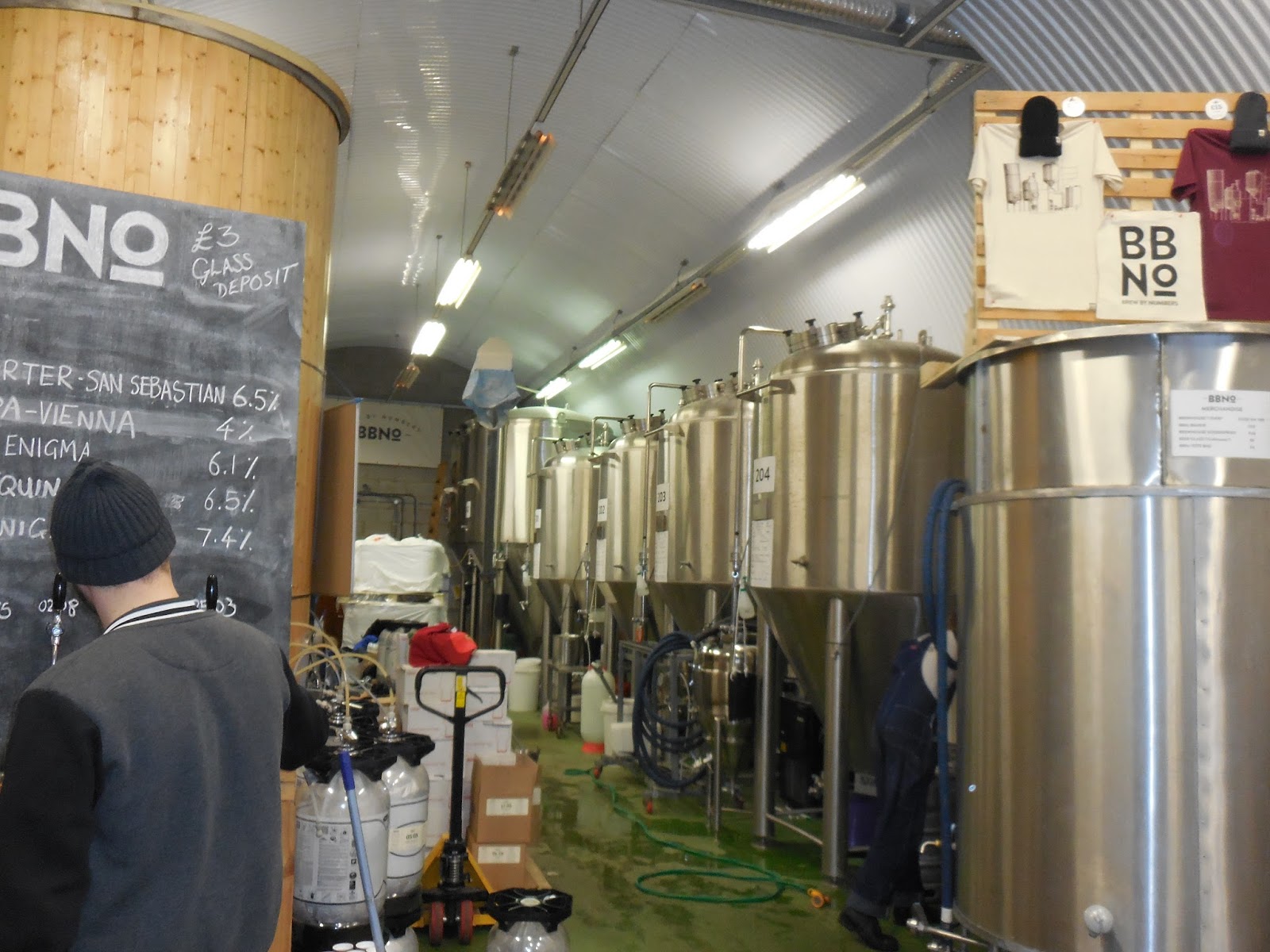
With two breweries down and the scoreboard still showing zero I didn't have high hopes for Brew By Numbers but I was pleasantly surprised.
 

Twice bitten and getting exceedingly shy I asked for a taster first but I needn't have worried with 0505 IPA. Strong, cold, fizzy, hazy, with citrus and pine. This was the sort of thing I was looking for in Craftlandia, and though I couldn't drink many of them I finished this one quite happily. One point to Brew By Numbers.


I believe it's BBNo. that got funding from Brewdog, and they were definitely way ahead of Partizan in terms of investment but they were still lagging behind Four Pure.

Our next stop was U Brew, which turned out to be a commercial home brewing operation, where for only £480 per year you can brew your own beer. Bargain, eh?

shiney, shiney

They didn't have any of their own beer on sale, but I think they are looking to install a commercial brewery. I had a couple of tasters I wasn't impressed by so I just asked for a Harbour beer. They sell their stuff in Sainsbury's so it can't be bad I thought. How wrong I was. It tasted like fucking quavers, so it's 0 for U Brew.

Next stop was Anspach and Hobday. You can't see the brewery here but there are some teeny tiny plastic fermenters at the back.


Still being in craft mode I had the IPA. I hit gold again with another one that was actually drinkable: hazy, hop and pleasant, so a 1 for Anspach and Hobday.


With only two out of five scoring on the Bermondsey Beer Mile things weren't looking good but I had high hopes for the next one. When we'd asked for directions at U Brew the bloke there rather dismissively said that Southwark Brewery did cask beer. "Thank fuck for that" I replied, and I wasn't disappointed.


Look at them there - lovely, lovely handpumps with proper pints of proper beer:


And you can actually see through the beer:


After my holiday in craftlandia I felt like I'd come home. So we stayed for two. The porter was full of flavour and very drinkable, if perhaps a little thin, and the Best Bitter was quite minerally but a delight on the tongue. As two beers were drunk that means in binary Southwark brewery score 10. And using the scientific scoring system we can see it's been proven that one cask brewery is as good as five keg breweries.

That has added to the growing realisation I have had that the proverbial CAMRA dinosaur is, in fact, me. So no more will I try to convince myself I have a wide ranging taste in beer. I shall resign myself to sitting in pubs, drinking proper beer that tastes like beer should, and writing angry letters to What's Brewing. Still, at least I can go back to ignoring keg beer.