Monday, 6 May 2024

A visit to Heineken's Murphys brewery

As someone who takes my Continuing Professional Development very seriously it was without hesitation that I booked on to the IBD Study Tour of Ireland. We started in Cork, a city I liked the look of:


Connolly was a Wobbly too and the influence of the IWW could still be seen on the side of the building...


... along with some nationalist drivel.

But on to the studying. The first stop on the tour was Murphys brewery. The brewery dates from 1854 when a distilling family bought a hospital and converted it to a brewery. The company was bought by Heineken in 1983. 


It can be a difficult task getting into breweries owned by large companies and they can be restrictive on what you are allowed to see. In this case for Health and Safety reasons we couldn't get in the brewhouse which was a shame. They can do 12 six tonne brews a day in it in two lauter tuns. Heineken, Coors, Fosters, Tiger, Moretti, Lagunitas, Murphys and Beamish are brewed there, the stouts being perhaps four brews out of a weekly 35-40. Cider is also made there from sugar and concentrate.


They can mash every two hours and ten minutes, lautering takes three house. They have a holding vessel between the lauters and the copper, and unusually the yeast propagation plant is in the Hauppmann brewhouse. Overall extract losses are less than 7%.

They have heat recovery on the stack on the copper and a heat recovery tank holds hot water which is used to pre-heat the wort via a Plate Heat Exchanger. They have four 120 tonne malt silos and two wheat malt silos (though it's used at less than 5% so presumably they're smaller). Chocolate malt and roast barley are used for the stouts (Murphys and Beamish respectively) and colour adjustment. Maize goes in the Moretti. They have CO2 recovery and are self sufficient in it. They used to do a lot of filling of gas bottles do but not only do a small about of 20L gas containers. 

Heineken has a mashing profile 55, 64 and 78°C and is brewed at 17°P to 7.5% ABV before being cut to a sales strength of 4.3%. I'm also got something down about them mashing at 60°C not 55. For the stouts maybe? It's to prevent ferulic acid formation so they don't get a phenolic taste from 4 Vinyl Guaiacol. Mash pH is 5.5-5.7 and copper pH 5.3-5.5. Calcium carbonate is added in the Mash Conversion Vessel and phosphoric acid in the copper. 

Their 20 head keg filler can fill 850 x 30L kegs an hour. 


Maximum brew length is 330hl. Six brews of Heineken will go in a single Fermenting Vessel. Horizontal FVs have to be used for Heineken as they only allow a maximum height of 4m so they get the right ester profile in the beer. Wort is oxygenated to 20ppm. Fermentation is at 12°C for 10 days and it takes 28 days in total to make Heineken. Cider takes three weeks and stouts are filtered after 10 days. The stouts are carbonated to 1.5-1.8 volumes of CO2 in tank and nitrogenated just before packaging.  


Pentair cross flow filters are used and for lagers (but not stouts) PVPP is used for stabilisation. Total production is one million hl a year, at a push they could do 1.2 million.  


Friday, 26 April 2024

On Brewing Education

This blog has lead me in some unexpected directions. Most recently to a very interesting conversation with Kathryn Thomson, the Head of Education and Professional Development at the Institute of Brewing and Distilling (IBD). So it seems rather appropriate to put something on the blog. 

The IBD is becoming the Chartered Institute of Brewing and Distilling, so we will have to start recording our Continuing Professional Development (CPD). I have for a long while been insisting that as a professional brewer every pint I drink is CPD but that does seem to have bitten me on the arse now that recording CPD is something I'll actually have to do properly. I don't suppose untappd submissions will count. The blog however might, my write ups of brewery visits whilst on study tours have been described as "great examples of reflective CPD". I may be a beer nerd but I'm also a technical beer geek! Well lubricated though those IBD study tours may be there's a lot of actual studying too. 

Kathryn is trying to develop a practical and pragmatic approach to CPD which sounded very positive to me. And I also got a chance to go off on one about brewing education which was great because I have opinions. 

Having studied brewing and distilling at Heriot-Watt and completed the IBD Master Brewer qualification I have done a lot of formal brewing education and it is definitely weighted heavily towards giant lager factories. These places may be where most beer is made but with the proliferation of craft breweries they are not where most brewers work. The IBD does seem to have recognised this as the shorter courses they've been putting out recently seem much more geared towards to needs of the smaller brewers. Which is nice. But the short courses don't count towards the formal qualifications so we did get on to discussing more American or Scottish modular system counting towards a qualification. 

We also discussed the engineering part of the IBD Diploma (module three). As I went to Heriot-Watt I got the diploma by exemption... as soon as I'd sent the IBD a cheque. So my learning of brewing engineering come from a lecturer that I could talk to and ask questions and as a full time student I had a friend on the course who helped me work through the maths difficulties until I'd got my head round them. Rather a different situation from someone on their own staring at a computer screen with no one to ask about what it all means. I loved it though and the distilling part more so (though I haven't forgotten the betrayal of theoretical plates*). I also got one of my highest exam marks ever for an engineering paper: if you get the maths right they have to give you 100% whereas a good essay might get 70%. How to provide learning material that makes tricky maths something that can be learned on your own remains a problem that will be tricky to solve though. Online mentorship would help but is not without its own problems, when the IBD had a forum it was soon overrun with spam bots and the IBD's linkedin group has several times more members than the IBD has. 

Speaking of learning material we then got on to the Master Brewer qualification, for which the IBD provides the square root of fuck all learning material. This does not overly impress me but I have to say my views were challenged. Is module four (resource management and regulatory compliance) really something the IBD should be providing learning material for, as there are probably other bodies better suited to such things? This is a very valid point but as the IBD is running exams about such things they could at least give you some pointers on where to look. We both agreed that the demise of the examiners report is definitely a bad thing. Not sure how they managed to get away with it really. 

In general the IBD could improve on learning material. The magazine nowadays isn't much of a learning resource, being mostly filled with corporate financial reports, advertorials and press releases. The journal has some cracking articles, all of which are easily available online, but most papers published tend toward more obscure matters. I mentioned that the MBAA podcast is a great for accessible learning about a wide range of subjects and is often being linked to a paper or presentation. 

I will be getting back to my reflective CPD shortly as I'm off on another IBD study tour next week and I'm very interested to see how I will soon have to be logging it. 


*You probably had to be there

Sunday, 11 February 2024

Finally visiting Sarah

I'd waited a long time for this. It was over thirty years ago that I first drank Sarah Hughes Original Dark Ruby Mild. I think they've dropped the "Original" from the name since then, but as I now know the locals simply call it "Ruby".

I have an 1990 programme from Farnham Beerex where I can see as a teenage beer bore I ticked it off:


I doubt I'd had it before then, and they'd only started brewing it a few years earlier in '87 anyway. I'm still a fan of the beer to this day and if I see it at a beer festival I'll drink it. I'd never actually got round to visiting the pub it's brewed in though. Over the years I have thought about it a few times and even looked in to accommodation but never actually pulled my finger out and made the trip. So when I saw work was taking me to Wolverhampton it was in fact to Sedgley that my thoughts turned. It's not blessed with a lot of accommodation so it's in Dudley that I ended up, a bus ride from my ultimate goal. 

I had another stop before that though. Pubs have a depressing tendency to close if not "spontaneously" combust so I made sure the route to my hotel took the past Ma Pardoes (The Old Swan) in Netherton. This is one of the few pubs that still brewed its own beer when CAMRA was formed and cask beer was saved. It has had hard times recently so really it's the duty of anyone in the area to call in. It's a cracking pub too.


I had a pint of the Original, a beer of modest strength, which was for the best really as I was driving and was on a mission for the rest of the evening. 


Once I got to my hotel room I checked the bus times and was off out in minutes as one was on its way. This did mean I got to the Beacon Hotel without eating but did that stop me charging in for a pint? Oh no!


The building is quite unassuming from the front and advertises wines and spirits. Wonderful interior though, with a little serving hatch in the room I ended was in. 


After my first pint of Ruby I nipped across the road to the chippy. The beer is 6% so best not drunk on an empty stomach. Then it was back for more. After finally getting there I wasn't stopping at one! It's great pub with great beer. More people were drinking Ruby than anything else as well despite the strength.


The closest I got the brewery was the brew house door so I really need to get planning another visit, and not wait so long next time!


Sunday, 31 December 2023

Golden Pints 2023

It's that time of year again.


 Best UK Cask Beer:

As the Craft Beer revolution seems to have run it's course I was pleased to see cask beer was becoming more prominent again at the Beer Writers dinner. Fuller's Vintage Ale and Gale's Prize Old Ale both served as god intended! Marvellous. Which one though? Let's go with Prize Old Ale as my mate Henry was behind its current revival. 


Best UK Keg Beer:

Hmmm...yes, definitely suckled at the devil's drainpipe this year. The best though? Oh yes, Queer Brewing barley wine. 

Best UK Bottled Beer:

Armagnac barrel aged Thomas Hardy Ale. Lovely, lovely, lovely. . 


Best UK Canned Beer:

My favourite sister got me some cans from a nano brewery for xmas which I must confess did fill me with fear. Cans from a nano brewery I thought, what's the dissolved oxygen on that? But my fears were unfounded and the beers are lovely so Middle Child Party on the naughty step. 


Best Overseas Draught:

That would be one of the 8% Budějovický beers guzzled from the conditioning tank. :-)


Best Overseas Bottled Beer:

What have I had this year? Not sure so I'll play it safe and go with Orval.


Best Overseas Canned Beer:

They've started selling Sierra Nevada beers in the shop at work and the Celebration IPA was very good. 


Best collaboration brew:

Have I had any? Not that I can remember. 


Best Overall Beer:

Prize Old Ale

Best Branding:

Not really my thing this so I'll just go with whatever Too Much Black Coffee have done for Thurstons again. . 

Best UK Brewery: 

Taking the unprecedented step of swerving from my beer choices and I'm going for Coniston as I had a great time visiting there. Great beers too.  


Best Overseas Brewery: 

Sierra Nevada


Best New Brewery Opening 2023

Can't think of one.


Pub/Bar of the Year:

The Crown again. I bet there aren't many pubs that will have a Sing-along-a-Wicker-Man night!


Best New Pub/Bar Opening 2023

Can't think of one of these either. 


Beer Festival of the Year:

GBBF. There was much wailing and gnashing of teeth from me when I heard there won't be one next year. I didn't do the rending of clothes though as it was a bit parky for that. 


Supermarket of the Year:

I don't buy much bottled or canned beer currently as I can blag them from work. I did do some stocking up when I was near a Booths though which makes them the winners. 


Independent Retailer of the Year:

 Cobbett's Real Ale is handy when I'm in need of something special so they're this years winner. 


Online Retailer of the Year:

Not my sort of thing either but I did get sent a case of beer by Gadd's so them. 


Best Beer Book or Magazine:

There can be only one winner this year: Desi Pubs by David Jesudason. Amazing stuff he's been writing and I got so into the book I managed to miss a train stop!


Best Beer Blog or Website:
 
This year it's Shut Up About Barclay Perkins.

Simon Johnson Award for Best Beer Twitterer:

Sadly the decline of twitter is continuing but I think Jessica Mason has been best for news this year so @drinksmaven


Sunday, 17 December 2023

A visit to Coniston Brewery

Back in the Summer (mid-October) I took the opportunity of being in the Lake District to visit Coniston Brewery. I have a work connection that was dead handy for getting in touch with Ian Bradley who runs the company. I'd been keen to visit for some time so I'm glad I finally got round to it. The brewery has won the highest award for its beers, The Champion Beer of Britain (CBoB), not once but twice, and with two (2) different beers.

The brewery has the cramped look so popular with breweries and the 10bbl brewing vessels are wooden clad. Whole hops are used, which have to be dug out of the copper by hand. 


Don't put your head too close

Fermenting Bluebird (CBoB 1998)

The conditioning tanks (CTs) are shinier and all hard piped in. One of them contains No. 9 Barley Wine (CBoB 2012) which is brewed just once a year. 


The CTs have their own CIP (Clean in Place) set too!


Bottled beer is also available.


The brewery is located behind The Black Bull, where bottles of Bluebird (CBoB) the tell us the beer is best served in s straight pint glass at 58°F. We put this to the test and I have to say the bottle's not wrong. Ian looked after us extremely well, not only keeping us well supplied with beer but giving us t-shirts too! We worked our way across the range up to the barley wine, which is not something you often see on draught. One of my friends hadn't drunk barley wine before and was mightily impressed. 


And even better the other friend I was with was driving so there was no trouble getting poured home. 


Thursday, 21 September 2023

Cask - the real story of Britain's unique beer culture by Des De Moor

A new book about cask beer, the pinnacle of the brewing art, what's not to like? And yet despite my love of cask beer I must confess I had concerns about CAMRA's new publication.


The author Des De Moor had previously written an article about hating pubs which had disastrous consequences on a global scale and certainly made me question if he was the best person to write the book. Pubs and cask beer are as close as lips and teeth so surely someone what hates pubs is no lover of cask beer?

So it was with an inquisitorial eye that I read the book. It covers a lot of ground, including many things I've researched myself so it's good to see it gathered together in a publication. It starts with details of how beer is made, packaged and dispensed. The latter surprisingly has autovacs, where beer from the drip tray is recycled, getting a positive write up! I have a morbid fascination with myself but really they are just minging. 

Cask is then compared to other lesser packaging and dispense formats before moving on to beer tasting and beer styles. This drifts away from cask beer and goes into foreign territory, discussing amongst others things Czech and German lagers, but strangely not mentioning their unfiltered and naturally carbonated forms, which surely is the closest cask equivalents. 

Food pairing follows, though once again crisps are overlooked, before going back to the prehistory of beer and working back forward to the present day. There's a lot on a subject dear to my heart, Brettanomyces and secondary fermentations, though I don't agree with some of the conclusions reached: that original IPAs weren't real ale and cask beer is a relatively modern invention. 

Cask is a large and comprehensive book about beer but despite it's subtitle it is not the real story of Britain's unique beer culture. There is hardly any mention of pubs at all and culture only really comes up in terms of yeast cultures! It's more a big book about beer and cask's place within it. Technically it is generally sound, the main problems were as I'd feared of a spiritual nature. 

As a man of simple faith I have had trouble adjusting to the ecumenical times we live in. I understand we should try and avoid offending heathens by denigrating the emissions of the devil's drainpipe, but our Mother Church still rightly teaches that cask beer is the pinnacle of the brewers art. So when Des wrote "Cask beer was already Britain's lager" I did think fuck off, bollocks, you're a cunt this is a poor analogy and out of step with with the detailed research present on other matters. 

We're also told that the problem with keg beer when CAMRA was formed was not that it was keg, but that it was bad keg. This is making the common mistake that the opposite of good beer is bad beer. Those of us with that follow the one true faith know that the opposite of good beer is in fact evil beer*. And later we see just how evil as Des confesses that "it's undoubtedly true that craft keg has abstracted volumes from cask". Even a godless heathen will realise that this is bad news for cask beer so I would have expected to see more concern about it in a book called Cask. The promiscuity of "repertoire drinking", where people are not faithful to one drink type, may no longer be anathematized but every pint of keg drunk is a pint of cask not sold.

Inevitably the reactionary position that cask beer should be more expensive is promoted, though to be fair opposing voices are heard. In the final section the author seems intensely relaxed about cask beer becoming a niche product but I can't help but wonder how much poorer the world of beer would be if our church's founding fathers had felt the same. Fortunately they founded a church militant, a campaigning organisation, and we must not tire in our constant struggle to promote beer served as god intended. 

The book contains a lot of good information but its theological shortcomings mean it can't be recommended to the general public and should only read by CAMRA members in good standing. 


* Yes I did gratuitously write that blog post purely so that if I ever got round to writing this review I could link to it. 


Tuesday, 5 September 2023

Castlehill Compleator

Some people keep score of the number of different beers they've drunk, and others tick off pubs in the Good Beer Guide. But how many have done the Castlehill Crawl eh? Me and my mate Si that's who. 

In fact we even stopped at a warm up pub, The Kingston Arms, before we'd even started. Oh yes. 

Swerved the Bass mind

We passed the old Dale's brewery on the way, closed by Whitbread in 1958. Whitbread were so fond of closing breweries they even sold off their own in the end.


We passed over the bridge from the Town bit to the Gown bit for our first official stop: The Pickerel. 


It was dead posh round here, the Cambridge universities having more money than you can shake a stick at. Cask beer was selling well though so well done students and tourists!

Stop two for us was the Castle Inn, an Adnams pub but I went for the beer from Cambridge Moonshine brewery and I'm delighted to say it was the beer of the day!


It was a big pub and we sat in the beer garden, which a helpful sign you could only see from the beer garden told you about. 

Think it through lads

The Architect opposite followed, Cambridge's first dedicated fish and chips and pie and mash bar. 


Yes, I thought that was a bit odd too. We were still in the dead posh end of town so you could buy dead posh snacks for your dead posh dogs here. 


The place also stank of fish so we sat outside. We headed up hill next to the pub at the far end of the crawl, The Grapes. 


Entering here it was obvious that tourists and students don't like going uphill as it looked like they were about to have a meat raffle. More my sort of pub to be honest. 

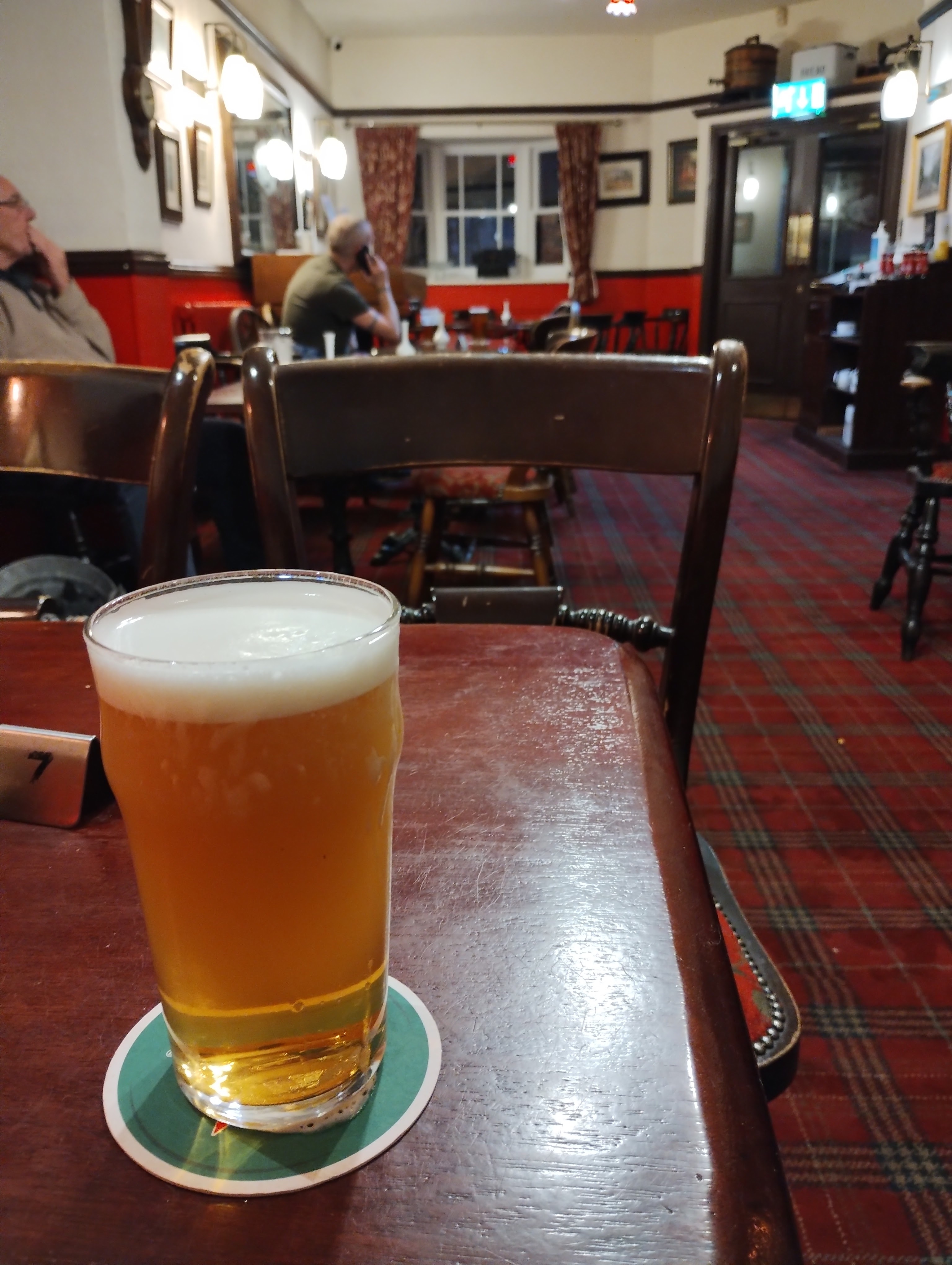
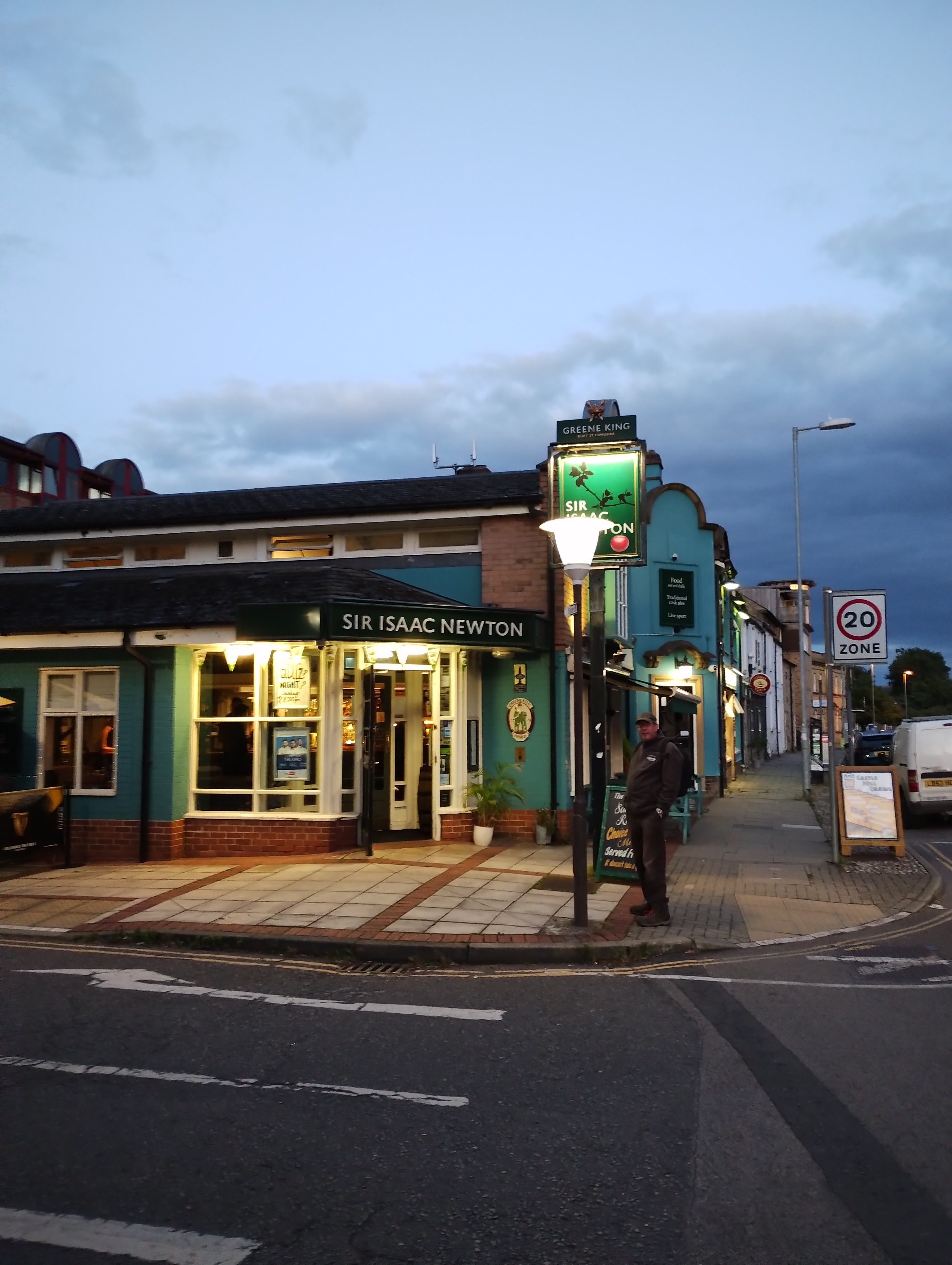
Then, much like our higher functions, it was downhill to our last stop the Sir Isaac Newton.


We finished on Old Peculier and slightly to the surprise of the person serving us (it not being at an end of the crawl) we got our last stamp. 


Five (5) stamps each in a different colour! Which I think shows how great our achievement was.