Wednesday, 19 July 2023

How much lager is really drunk in Britain?

After a hard day's Continuing Professional Development there's nothing better than an evening of Networking. It's like CPD but with more drinking and less technical stuff.  

You can learn a lot when Networking too. As I did recently when I was gobsmacked to hear that Fosters is brewed with an ale yeast. Which given the way beers are generally classified nowadays means not as much lager is drunk in Britain as was thought.  

Ale or Lager?

I have pondered on the problems with classification previously. Would it really help anyone if Fosters was reclassified as an ale? I don't actually know what it tastes like, I might have drunk it as sometimes needs must but I can't remember. I'd be very surprised if it doesn't fit the flavour profile and specifications of industrial lager though, which is surely what people buying it are after. Still, I guess I've got another thing I can bore my non-beer geek mates with. 


Monday, 3 July 2023

A visit to Budweiser Budvar brewery

Last stop on the study tour was Budějovický Budvar or the Budweiser Budvar brewery. As someone who drinks in the ways of righteousness I've never been much a lager drinker and I've always preferred Pilsner Urquell to Budweiser Budvar. But our mother church did campaign to keep it independent and it is a fascinating brewery. Ninety days lagering! Bonkers I tell you. 


The head brewer was there to meet us and show half the group round. He said we could take any pictures and they have no secrets, "what we do is in the text books". 


The brewery was built in 1895 on the road to Prague above a good water supply. We passed a couple of massive water tanks and when I asked how big they are some wit piped up "πr2h" but failed to provide a tape measure so I remained ignorant. 


Actually the brewer showing us round did tell us and my ignorance is due to me getting lost somewhere in the explanation. They're definitely big though. They remove iron and manganese from the water by aerating it and whirlpooling it in the water tanks, which is a new one on me. I did a lot of work on brewing water a few jobs back but I'd never come across this. It does leave a sludge so every couple of years they have to drain the tanks to remove it. 

The 300m deep well

With annual production at 1.8 million hl a year and growing they're reaching the limits of the water supply. The water to beer ratio is 4.5-4.6: 1 and they're trying to get it down to 4:1. 

The had an automated warehouse built seven years ago and it's decoration is based on the Czech flag apparently. Maybe if you squint enough you can see it. 


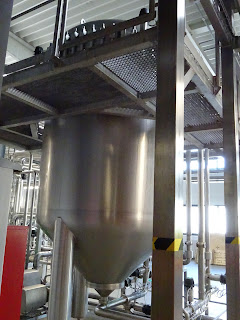
Unsurprisingly there are lots of big tanks ...


... and gleaming copper! 


It's copper cladding over stainless steel. But still, an absolutely stunning brewhouse. 


They weren't brewing when we were there but normally do 12 brews a day with two sets of vessels. A third set is being planned. They do double decoction mashes and you can consult a brewing text book for more details. Oh alright, decoction mashing is a primitive European way of brewing that was developed before the invention of the thermometer. By mashing in at blood temperature and removing and boiling a portion of the mash (typically a third) before re-mixing it with the rest of the mash the temperature is raised in stages which hit the optimum temperature for the action of different enzymes (proteases, beta-glucanases and amylases) needed to get starch from poorly modified malt broken down into fermentable sugars. It does have the additional benefit of driving off the unpleasantly flavoured DMS (dimethyl sulphide) which plagues many lagers. 


There are four brewing vessels per brew stream: Mash Conversion Vessel, Mash Kettle, Lauter Tun and Wort Kettle. The have a hop separator (screw and screens) before whirlpooling. Spent hops are mixed in with the spent grains and go to farmers. The brew length is 600hl. 


Your chance to improve your knowledge of Czech brewing terms

For Budweiser Budvar it's 10 tonnes of lager malt and approximately 120kg of whole cone Saaz/Žatec hops which are added by hand. So it's a SMaSH (Single Malt and Single Hop) beer, something I try and avoid as a professional brewer because it leaves you vulnerable to supply shortages and seasonal crop variability. They have three hop additions, at start of lautering, at start of boil and near the end of the boil. 


The beer has a colour of 10 EBC and though (apart from the hop additions) the brewhouse is highly automated they still run wort through the taps at times as it adds 1 EBC of colour due to oxidation. They don't believe in hot side aeration problems! The bitterness is 22 IBU. 


They collect the wort at 7°C and it rises to 12°C during fermentation, which takes 10 days for 10°P (1.040) beers and 12 days for 12°P (1.048) beers. 


Budweiser Budvar, which makes up 80% of production, is matured for 90 days at 0-3°C so they have 300,000 hl of maturation capacity. Amongst other things they've got the 90 days maturation written into the PGI (Protected Geographical Indication) which will surely prevent anyone trying to brew a Budweiser elsewhere. 


Our hosts did deliver when we got to the maturation area.

Getting closer

Bring on the CPD!


Sumer is icumen in

We had a glass of Budweiser Budvar from the tank before moving on to try some experimental beers. 

The brewer showing us round brought his woolly hat for the cellars, which I'm sure those in shorts and t-shirts were jealous of. I can smugly state I'd brought a fleece.

They had three tanks filled with beer from hop trials. One of them we were told was a cross of Saaz and Jester, which isn't physically possible what with brewing "varieties" being female plants but still, interesting all the same. We we left to help ourselves to the trial beers and at this stage I was reminded that there's always more to learn about beer. One of people in the first group managed to get separated when they left so was forced to stay with the second group until we left. I guess he was going "full gas".  Whether it was a happy accident or masterstroke I couldn't say, but it is something I'll be remembering for future brewery visits. 

See the joy that doing CPD brings!

One thing I didn't find out was why exactly a brewery mostly making a 5% ABV beer chose to make its hop trial beers which will pretty much only be drunk by brewery staff 8% ABV. A complete mystery that one. 


Unlike most large breweries they still used manual flow plates instead of automated values for controlling beer/wort/yeast/cleaning fluid movements to and from tanks. This also caused us some confusion until it was pointed out to us that tanks were only used four times a year!


On the way to packaging to my surprise and delight I saw there's a brewery railway. I never even knew I had an inner train spotter.


It's the sort of thing I've only seen before in brewing history books  


They use a kieselguhr filter on the beer prior to packaging. They have three bottling lines, one canning line and a keg line. The bottling lines have 108 head fillers which run at 40,000 bottles per hour. 

The tunnel pasteurisers give 20-25 pasteurisation units to the beer.

Then we exited via the gift shop, and I'd enjoyed myself so much I was even tempted to buy something before I remined myself that most of my wardrobe is brewery branded clothing as it is. 

Saturday, 1 July 2023

A visit to Proud brewery in Plzeň

After the excitement of the Pilsner Urquell brewery we went on to Proud brewery, housed in the site's old power station. We were an hour and a half late by the time we got there. A problem with taking groups of brewers round breweries is that progress is often slow. Too many questions!


The Head Brewer

Being built by a large multi-national owned brewery no expense seems to have been spared in building Proud. The work on the building alone must have cost a fortune. 

Our tour guide repeatedly told us to look out for the only tiles with hops on so I'm delighted to share the excitement with you:

The brewing vessels were in use so we weren't allowed near them. Boo! The first brew (an English pale ale) was in September 2020.


It's a five vessel system with whirlpool and a wort receiving vessel so they're able to get through six to nine brews a week in two to three days. They have 415 tonne malt silos, which last two months, with speciality malts in sacks and big bags. 

They have cylindro-conical vessels of 30, 60 and 90 hl capacity.


Looks like another candle filter to me Al


Wooden barrels, which no respectable craft brewery will be seen without


We had a bit more time for drinking networking here, but still not yet going full gas. 

Tuesday, 27 June 2023

A visit to Plzeňský Prazdroj brewery

Being back in Pilsen all I had to do was walk across a bridge to get to to the Plzeňský Prazdroj or Pilsner Urquell brewery. Someone in the group still managed to be late, but he was young enough to still enjoy the glory of oversleeping so it wasn't all bad for him. 


We were met by the head brewer.


And a former head brewer who gave a talk for us before the tour. In a glorious bit of non-native English he said they had more of the sample beer than they could drink so we should go "full gas" when it came to drinking. 


Unlike last time I was there we got to see the maltings. They only make Pilsner malt, no calling it extra-pale or lager malt here, with a Kolbach index of 36-37 (that's on the low side). They produce 88,000 tonnes per year, enough for all the breweries on site (as well as PU there's Gambrinus and the Proud microbrewery) and Velké Popovice.

They have two steeps at 15°C over 28 hours where the moisture rises from 13-14% to 42-45%. There will be an air rest between the two steeps so the embryo in the grain can breathe. There are eight Saladin boxes with a capacity of 212 tonnes where the barley spends six days at 15-18°C. It's turned six hours after steep out and then usually every 12 hours. There are three kilns and they're all used for each piece (batch). Kilning takes 16-17 hours with a final temperature of 75-80°C. After 21 days the malt goes to the breweries. 

The barley variety is the Spring barley Bojos. 

A maltster and a Saladin box.

Then it was packaging. Lots of big machinery and bottles moving around at unfeasible speed. There are two bottling lines at 60,000 bottles per hour, a canning line at 60,000 cans per hour and a canning line at 40,000 cans an hour for specialist products (!). The bottling lines have 168 head fillers. 

They flash pasteurise most products, though there's a tunnel pasteuriser for some speciality products. They mostly pack in returnable 500ml bottles so there's a bottle washer. The turn around time for bottles is around one to two months. Some 330s are filled, and some recycled cans are used. Brown bottles are used for US and UK export, the rest are in "UV protection" green bottles. Beer is carbonated to 5g/l (2.5 vols)


Next we went to see the filters. They have a kieselguhr candle filter and two 72 module cross flow filters which filter 600hl/hr of high gravity beer down to 0.45 micrometres. The filter modules are changed after 400 CIPs. Pentair is paid a fee for them by hl filtered. The cross flow filters are better quality than the kieselguhr filter but cost more. 

There's also a PVPP filter.

Cross flow

Candle

Unlike in brewing fermentation followed after filtration for us. They have 30 x 2500hl and 40 x 800hl cyclindroconical fermenting vessels and the maturation tanks are 56 x 3200hl and 28 x 5000hl CCVs. They ferment from 6° to 9°C for 14 days and mature for 20 days at 0°C (+/-1°C). Cooling is based on the PG (Present Gravity) of the beer not the diacetyl level, which is 85ppb in pack. They have 76-77% apparent attenuation and gravity drops 0.2°P (0.8°S) during maturation.


As you might expect there were lots of pipes and automated mix proof valves. 

One's gone red

Our hosts were thorough so se even got to see the cooperage:


And then be got to the brewhouse. Or rather brewhouses, this is the old, disused one:


There used to be 30 sets of vessels. 

This is the new brewhouse:
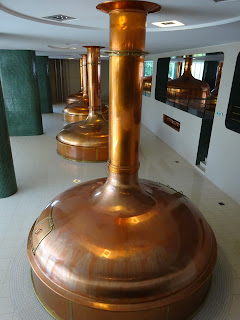

Wort kettles


10.5m diameter lauter tuns and 10.5 tonnes of malt per batch. Loading is 150kg/m2 and lautering takes 2.5 hours. OG is 12.2°P (1.049).
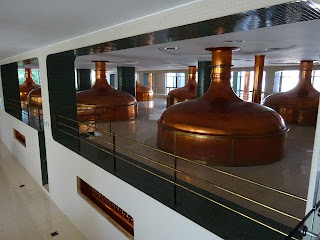

mash kettles

Brewlength is up to 625hl. They do 24 x 600hl brews per day, running 24/7 making 5.2 million hl a year. Saaz/žatec, sladek and premiant hops are used. There three additions at the start of the boil and 60 and 80 minutes in to it. From which I'm going to infer it's a 90 minute boil. 

Then it was into the cellars, there are 9km of them. 


Some beer is still fermented in open wooden fermenters and matured in wooden barrels, which I guess keeps the coopers in work. We're told they do this to ensure that the taste isn't different from when it's made in the modern vessels. I don't believe a word of this myself, firstly because fermenting and maturing in giant CCVs is definitely going to make a difference and secondly because it does actually taste different. I didn't notice any diacetyl and the bitterness came through a lot more. Lovely it was. Sadly we were running late so didn't get to go "full gas" on the beer which is a shame. 


If you want to look at the fermentation profile in wooden vats here it is:


They use their own lager yeast strain which is used for four generations. 

As to the famous Pilsner water I'm not entirely sure what they do with it. We weren't with anyone technical when water was discussed and though I can't fault our tour guide's English I'm not sure about his technical knowledge. He said the water has its iron removed so it is deionised. Which left me confused. Was it iron or ions? Probably the former I would guess from something we learnt later in the study tour, and Pilsen water is famous low in ions anyway. 

After all this we went to the onsite microbrewery but I'll leave that for later...