Saturday, 24 March 2018

A visit to gin lane

Yesterday had a rare departure from Beer Street and Visited Gin LaneSipsmith gin mind, so posh stuff, though it must be said it didn't look posh from the outside.


There's plenty of gleaming copper inside though. Copper is important in distillation as it removes sulphur character.


Gin distillers generally buy in alcohol at 96% ABV and re-distil it with botanicals give it flavour. Which has always sounded like cheating to me but it was interesting to hear that the base spirit does give some character to the gin. A Sipsmith they use a wheat based spirit which gives some vanilla flavour, grape bases ones are more fruity and molasses give spice.


The base spirit is diluted to 40-60% ABV before distillation with the botanicals. Sipsmith are at the high end starting the distillation at 60% ABV.

The rectifier for the vodka they make
They use ten botanicals. Juniper legally has to be the predominant flavour in gin and it also adds pine and resin notes. Coriander is the next most important and gives citrus, lemon/lemon grass flavour to the gin and Angelica root is the third most important giving a dry floral flavour like parma violets without the sugar. Orris root is said to act as a fixative for flavours and is high in polyphenols. Liquorice adds sweetness and cassia gives aniseed. Cinnamon comes over quite subtlety after distillation, almond adds mouthfeel and lemon peel is, well, lemon.

Almond not on display in case anyone is allergic to nuts

They boil at 80°C and the vapour passes through narrow pipes in the neck of the still into the helmet at the top where it expands which promotes reflux.
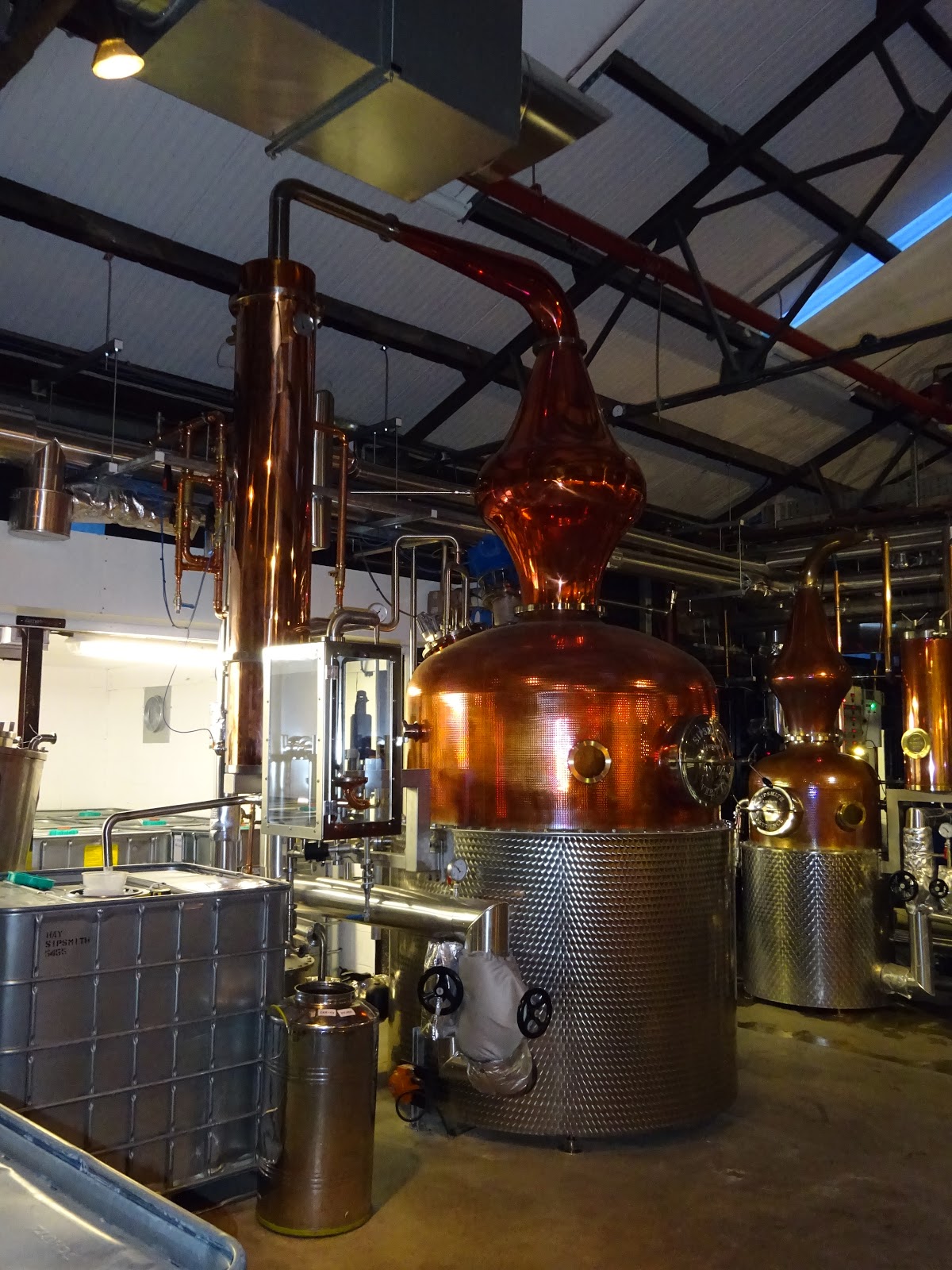

The light vapour that escapes the still goes over the swan neck and is condensed. Despite starting with a 96% pure spirit base the heads are still high in methanol and acetone so are no used. The heart is used for the gin and will come off the still over five hours. The tails have poor character and are not used either. They are high in isopropanol but most of the poor character is due to vegetable (parsnip) character and fatty acids from the botanicals. 


At Sipsmith the heads are approximately 5% of the distillation, heart 80% and tails 15%. Some distilleries will re-distil the first part of the tails but they send all the heads and tails away. The cuts can be decided on ABV (heart 80-70% ABV), volume, flavour (nose), bubble size in still (it changes during the distillation) and temperature of vapour (83-87°C). 


They cut the heart with de-mineralised water to 41.6% ABV to make their "one shot" London dry gin.  


There are also concentrated gins made with 20-30 times as much botanicals which will be cut with alcohol and water to make the gin, distilled gins where some of the botanicals are distilled separately and compounded gins where the base spirit is simply flavoured without distillation.

We had a taste to three different cuts from the heart of the distillation and they were noticeably different. Hydrophobic compounds will to some extent go over the still earlier than their boiling point would suggest, sweetness and glycerine come over more in the third hour.


If peppercorns are used as a botanical the flavour comes over really late so  they don't work well with fruit which comes over early.  


It was an interesting visit, and the first time I've drunk gin in a long while.


It still tastes better with tonic in it though.

Monday, 19 March 2018

Finally a decent advent calendar

Back when I were a lad we had an advent calendar. We used the same one each year, it was made of layers of card with numbered doors on the front about the size of postage stamps. When the right day arrived the door would be opened to reveal a picture. It was not massively thrilling, but Christmas drawing closer was so I suppose it added to the excitement in a small way. After Christmas the doors would be folded back and it would be put away for next year.

Nowadays you can get advent calendars with toys, chocolate and booze behind the doors. Not the sort of thing I'd actually spend any money on but when I was offered a free beery one there could only be one answer.

As I usually do I enjoyed drinking the free beer. Particularly as since I finally found some German beer I really enjoyed I've been keen to learn more about the fourth ranked Great Beer Nation. This selection provided a great overview of German, and quite possibly Austrian, beers: pale lagers, dark lagers, wheat beers, bocks, dopplebocks and even a pale ale. Though as I don't know a much about German beer I can't really rate how respected the breweries are. Except for Salvator which I was very pleased to see as I'd even considered buying some shortly before the box arrived.


There's also a ludicrously thin beer glass that you won't be able to wash up unless you have a dishwasher but more importantly the Germans seem to be big on re-using bottles. So they're all thick bottles with easily removable labels are a welcome addition to my homebrew stock. And one of the bottles even came with a Santa hat:


Admittedly it's not quite as exciting as a pump clip with a flashing LED but it still amused me, cheers Kalea!


Wednesday, 14 March 2018

Greene King's Heritage Beers

I can't think when I've last put as much effort into finding beer as I did with Greene King's heritage beers. Three bleedin' trips it took me before I found them and even then it was only because I saw on twitter they had been reduced to clear that I wandered away from the beer section and found them in another display.


Still, on the plus side they were reduced to £1.87, which seemed very reasonable, particularly as the strong one is 6.5% ABV. It was in fact the pints bottles that caused my, and Tesco's, difficulties. They're made to a historic bottle design and so of thicker glass. The cardboard trays the bottles come in couldn't cope with the weight so the bottles were insecure. Tesco's response was to try and shift them as quickly as possible by giving them a massive display and a cut price.

Two beers "inspired" by records from the 1800s have been produced in the heritage range, both made using pale malt made from Chevallier barley. Chevallier is a land race barley that once the most popular variety in Britain. The Suffolk Pale Ale at 5% ABV also uses land race hops: Saaz and Strisselspalt. The stronger beer went a little off piste as one of the hops used (Bramling Cross) comes from Wye College breeding programme that started in the 20th century.

I didn't get upset by this though, as unlike some brewers that wander they didn't claim to be following a specific recipe, and I was keen to try beers made with Chevallier. The beers taste great too, the historic inspiration certainly made them crank the hops up from what's normally found in Greene King beers. More beers are planned for the heritage range and I look forward to seeing what comes next.

Wednesday, 28 February 2018

Networking and CPD in Edinburgh

Last weekend I was back in Edinburgh for some Continuing Professional Development and networking. I went via the Lake District so I could get in some snow, having felt left out in Surrey.

This is not Edinburgh
If I'd known Snowmageddon was coming I might not have bothered, but nevermind I'm sure it was character building. Particularly the bit when I found the limitations of Grivel spiders whilst high on a steep slope of hard snow.

Events in Edinburgh started with a a pub crawl on the Friday. I skipped the first stop, The Hanging Bat and went straight to The Blue Blazer. It was packed when I got there but some experienced loitering soon saw me shifting to a vacated table where I could await my fellow crawlers in comfort.

The Blue Blazer
We ended up having two pints in here as people gathered, but made up for it by missing the next pub on the list and going straight to the Bow Bar. My dad used to drink there when he was a student at the Royal Dick.

The Bow Bar
Again we had two pints here. Rather reckless behaviour on a pub crawl if you ask me, but at times like this you just have to go with the flow. We skipped a pub again which made up for it a bit and went straight to The Malt Shovel.


Here there was a delicious range of beers from Greene King. The Scrum Down was surprisingly bananery. The Greene King esters I was informed.

Things were definitely getting messy by this point as we then had an unscheduled stop at The Halfway House, where I had another rugby beer that was considerably worse than Greene King's offering. Horribly astringent.


The Halfway House

Never mind we were into the home straight. At The Guildford Arms they had Jarl on so I went for that and at the last stop, The Cafe Royal, I had nothing as I was keen to be able to find my way back to the hotel.

The Guildford Arms
Networking and CPD resumed on Saturday lunch time at Andrew Ushers.

Andrew Ushers
The free beers were both pale and hoppy and served from the evil keg. I have to say I did find them too cold and fizzy. Perhaps hoppy beers aren't suited to keg dispense?

The main event was the evening dinner with beer supplied by Timothy Taylor's.

More giant beer mats?
The main speech from Peter Ells, their recently retired Head Brewer, was a cracker. I was slightly disturbed by some comments after it from the chairman though. He said the students present had an excellent opportunity to network and speak to potential employers. Does this mean I've been doing it wrong? I thought "networking" was just a synonym for "getting pissed".


Monday, 19 February 2018

Heineken H41

Lager yeast, Saccharomyces pastoriaus, has long been known to be a hybrid species with Ale yeast, S. cerevisiae, as one parent. It was only in 2011 that the other parent, S. eubayanus was discovered. A couple of years back Heineken started making a beer with a strain of this yeast and I finally got my hands on some recently. I was very curious to see how it tasted, after all, under the beers classified by their yeast system this is an entirely new kingdom of beer.


As it turns out, the S. eubayanus used by Heineken has a lot in common with other wild yeasts: it makes a spicy, phenolic flavour. So as far as flavour goes it's more like it's made with a wheat beer yeast than anything else. Not massively exciting, but I'm glad my curiosity has been satisfied at last.


Friday, 16 February 2018

Carlsberg's new barley varieties

I'm sure like me you've been trying to figure out what's going on with the new Carlsberg barley varieties written about in Beer magazine.


This account looks a little confused to me so I had a go at seeing what I could find. Null-lox barleys have been around for a while now, they lack the enzyme lipoxygenase so ultimately make beers with lower levels of the cardboard/paper tasting aldehyde formerly known as trans-2-nonenal (T2N). Of course you could just stop under kilning your malt or pay more attention to oxygen pick up and storage temperature.

I didn't get what this had to do with sweetcorn flavoured DMS though, but digging around it seems that breeding with null-lox barleys has moved on and they have now been bred to produce less DMS precursor too.

So that's the paper and sweetcorn flavours accounted for, but I couldn't find anything any mention of improved clarity. However, as barleys have already been bred that are free of the haze forming polyphenol proanthocyanidin perhaps that trait is being bred in too. 


Wednesday, 14 February 2018

A research trip to London

One advantage of being on the sausage is you have more time for drinking. So with no worries about work I joined my local brewery on their belated xmas do researching pubs in London.

We had a brief stop in Surbiton to check out The Antelope, a pub with a brewery out the back and no Stella.


They did have an unfeasible number of beers on though.


As it was a marathon not a sprint I had their very pleasant session bitter. The barman would be hard put to out beer bore me so no complaints there and place wasn't busy during our visit so I can't comment on the hippy/trendy crowd. Though the barman was wearing dungarees which is probably a sign of something.

The day's main target was our next stop: The College Arms near Tottenham Court Road.


They've recently started selling Horsell Gold, another session beer.


It was good, but I'm sure it tastes better in Horsell. We hadn't made any plans for after but fortunately people on twitter had helped me out with suggestions.

The Fitzroy was another cracking Sam Smiths pub.


Feel the history! Or possibly marvel at the refurbishment.


I even enjoyed the Old Brewery Bitter. There are apparently five products in Sam Smith's pubs that aren't own label and Angostura bitters is one of them. As usual I failed to spot any of the others, though it was suggested the toilet paper may be one of them.

No sparkler was used in the serving of this pint
Speaking of which, for some reason there were photos of George Orwell around the time of the Spanish Civil War on the way to the toilet. And they weren't by Vernon Richards.


From the old and traditional we moved on to the modern and murky.


It was a hoppy beer but I don't believe for one minute that level of murk comes from just hops. When I used Vermont yeast I found it totally non-flocculent so I fined it before bottling, which brought it down to a much more pleasant looking slight haze and funnily enough the finings didn't totally destroy the hop flavour.

 We headed sarf after that for some Harveys.


Mild, bitter and Old were on. I went with the latter to bring me back into balance after the previous modern hop monster.

Then it was on to The George, the famous galleried coaching inn. But who wants to see famous galleries? So here's a picture of a room inside:


If I remember rightly I started on a pint of something weak from Wimbledon and then had ...er... something else. Yup, it was time to go home after that .