Wednesday, 12 December 2018

Parti-gyling at Fuller's brewery

A couple of weekends back I went to a home brewing convention. My plans for meeting up with people didn't go entirely as expected as I bumped into Ron Pattinson by the bar as soon as I'd arrived. Take it from me, going drinking with Ron does not do anything sticking to your plans.

There were a series of talks at the event and annoyingly the organisers hadn't put a timetable online. Luckily I was in time to get to the talk that most interested me, John Keeling the former Head Brewer at Fuller's talking about parti-gyling.


Parti-gyling is a way to get several different beers from the same mash, and Fuller's can potentially get Chiswick, London Pride, ESB and Golden Pride by separating the strong and weak wort into different coppers and then blending different proportions of the worts into fermenters.


John kicked off with an interesting insight into what's needed in a brewing team. He's always said you need brewers, engineers and quality assurance people, but he would now add a home brewer (though the home brewer would need to be trained up!).


He was firmly of the opinion that mash tuns produce the best wort, with less undesirable components than you get from lauter tuns. Though to be fair to continental brewing methods the places I've worked at which have lauter tuns re-circulated the wort until it was bright, which isn't something I can say about all the places I've been at with mash tuns.


Fuller's sparge to 1.005.


Fuller's have two mash tuns and two coppers, which is definitely a greater capex cost! Sadly no quadratic equation was shown during the talk. I strongly suspect they're something I could once do, so it would have been nice to see an example of the calculations and see if I could make sense of it!


Scaling up mash tun and copper size makes it harder to do small volumes of beer, and running two streams in parallel means using more energy [and fighting over utilities!]. So the strong worts (1.080) are fed into one copper and weak worts (1.018-1.020) into the other.


Proportions of wort from the different coppers go into different Fermenting Vessels (FV).


To hit target gravity Fuller's aim to be 5% over and then cut to target strength in the FV (this is liquoring back not be be confused with high gravity brewing which I really should post about one of these years).

As Fuller's go back a bit they have extensive files. 


There were bottles of modern ESB and the Past Masters version using the 1981 recipe. I managed to get a thimbleful of the latter. Pah.


The modern brew is all malt, but back in the day it was 6% flaked maize in the mash and some sugar was used. The adjuncts are handy for nitrogen (i.e. protein) dilution which helps with beer clarity and the sugar also has the added benefit of helping you make more beer without bigger equipment.


There were some questions and answers after the talk, and for those of us with a well filled beer cellar it was interesting to hear that John is now of the opinion that Fuller's Vintage Ale is at its best after 10 years. Which as is often the case makes me think that more research is necessary ...

Monday, 26 November 2018

A visit to Bath Ales brewery

The latest IBD Southern Section seminar was at Bath Ales, a brewery bought by St Austell in 2016.  They've obviously been investing a lot of money as the were shiny new things everywhere.

Brewhouse has a Mash Conversion Vessel, Lauter Tun, Copper and Whirlpool as well as a hop infusion vessel.  The brew length is 90hl. If I remember rightly they're currently brewing twice a day.


They have a four roller mill.


More space is devoted to packaging.


There were lots of casks soaking when we visited as they'd come back skanky. If only publicans would cork them cleaning would be a lot less effort!


The cask washer was bought by Bath Ales from St Austell, so when St Austell bought Bath Ales they bought back their old kit!


Here's underneath the brewhouse:


And there's the hop infusion vessel:


The flow plate looks pleasingly simple:


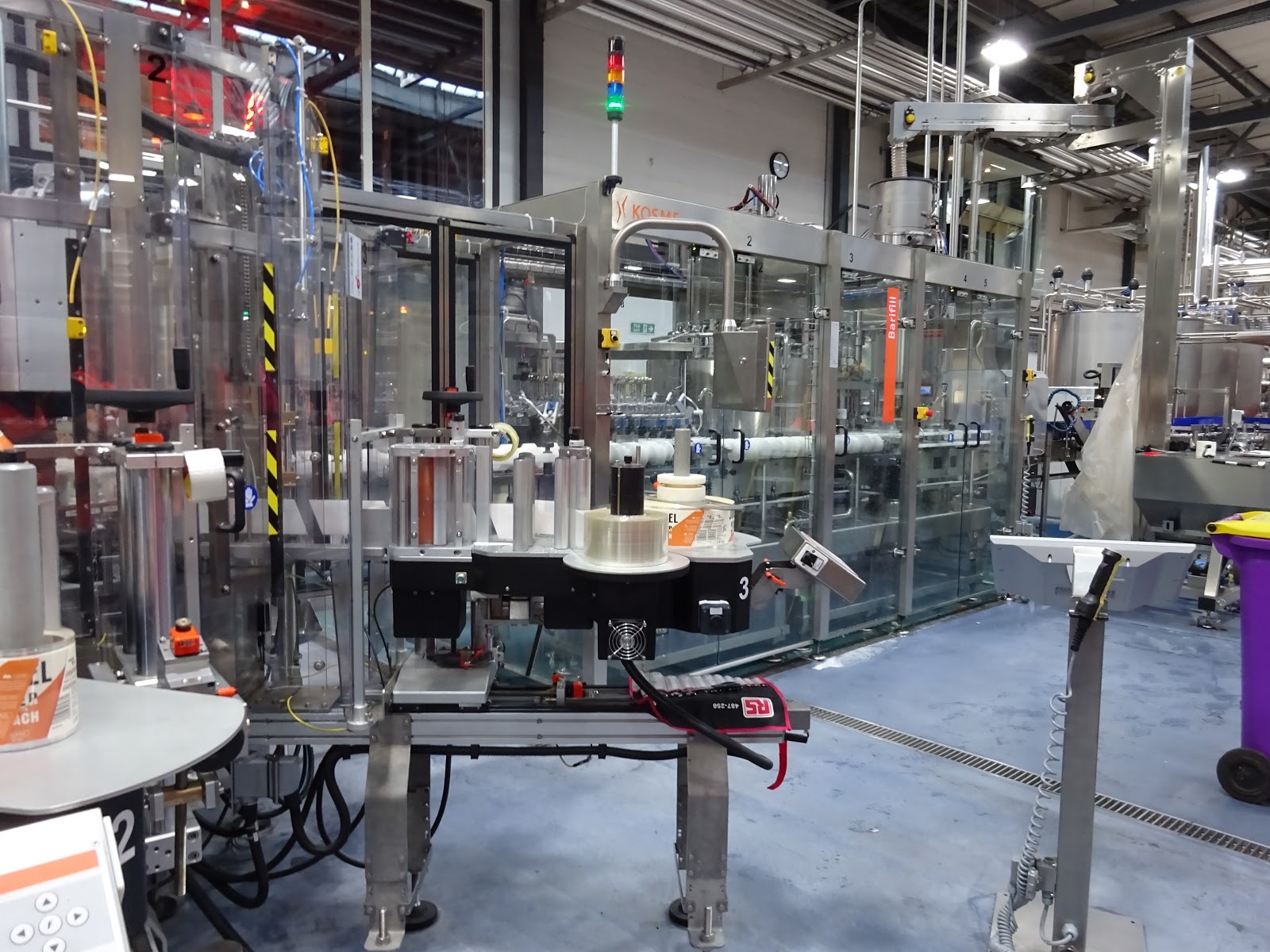
The bottling line looks very flash, but as is a tradition or an old charter or something it wasn't running when we were there.


They've got a cross flow filter from Pentair which doesn't need a centrifuge. One of the talks at the seminar provided information on this and I really must write it up for the blog. I know Alan has a keen interest in kieselguhr free filtration.


It was promised that the slides from the seminar will be put online, but as far as I know this hasn't happened yet, and unless this changes me writing up my notes will be the best you'll get.


Saturday, 17 November 2018

Crisp's new malt sacks a great innovation

Crisp Maltings have started sending out their malt in new sacks that are opened with a tear off strip.


I've been in two minds about them myself. No more cutting the string and teasing out the thread, but the strips sometimes snag and the sacks are smaller, making them more difficult to handle when opened. And you lose the satisfaction of a job well done when in a moment of zen calm you pull the thread out:

Om mani padme hum. Or should that be nam myoho renge kyo?


I don't like being stuck in a limbo of indecision. So as the ideas of the ruling class are in every epoch the ruling ideas I decided go with the current fascination for The People's Will and determine if the sacks were good or bad by a twitter poll:
The results came in with a resounding victory for them being a great innovation. The margin of two to one being an even bigger mandate than the previous biggest mandate ever of 52:48. So nice one Crisp, I look forward to using your sacks again and I shall not give another though to the redundancy of my carefully acquired string removal skills and the loss of job satisfaction.

Friday, 2 November 2018

A visit to Timothy Taylor's brewery

I don't really have time to organise visits for the Brewery History Society at the moment, but no one has volunteered to take over the job. So when I can I'm organising a few trips, and strangely enough I somehow managed to find the time to organise a visit to Timothy Taylor's brewery.


My obsession with Landlord is entirely unrelated to this.


The brewhouse came from the wrong side of the Pennines, originally being from Oldham brewery. They recently added a new Steel's masher.


The mash tun was filled almost to the brim, giving a brewlength of 180 barrels which is liquored back to 250 bbl. They still work in Fahrenheit and unfortunately I brew in Celsius. Figures were kindly translated for us and they mash at 66°C for an hour, then underlet raising the temperature to 70°C and leave for another hour.


They use only whole hops and add more hops in the hop back.


A lot more hops go in the copper though.


And I bet it's a right pain in the arse filling those bins. The use WGV (Whitbread or is it White's Golding Variety), Fuggles and Savinjski Goldings, with true Goldings also being used some years.


Brewing sugars are used in wort production and priming sugar is added to the casks.

Blocks of No.2 there


They carry out a range of lab tests in house...


...including using an antique Lovibond meter. Modern colour determination only measures colour at one wavelength (430nm) which does not give the full picture so they compare the colour of their beer to tinted glass slides by eye.


They ferment in open squares and rouse the yeast during fermentation. The yeast also came from Oldham brewery and they've been continuously re-pitching for 36 years.


They crop the yeast by skimming it off the top.


Newer vessels have lids that can drop down and seal the tanks. Which makes CIP (cleaning in place) easier and allows them to be used as conditioning tanks.


They now have a five barrel pilot plant which has been used for brewing some small batch beers.


Production is over 80% cask, with the rest being bottled at Robinsons. Annual production is 61,000 barrels so unsurprisingly they have very snazzy cask washing and racking equipment.


They still have to bang in the shives by hand mind.

With the casks being primed and racked with a yeast count of 2 million cells per ml there is a vigorous secondary fermentation. They recommend the cask is vented and left open for 24 hours before adding a soft peg.

The tour ended with a look at the Quality Control.


Very important that bit.


Sunday, 28 October 2018

Triumph and agony

It's been ages since I've seen a band, but a run of gigs started on Saturday with the return of several crusty bands I saw a lot of in my youth. It was at the New Cross Inn, which looks and sounds like a pub but I'm not sure if it actually is one.


I was delighted to see they had hand pumps on the bar. Until I tried drinking the beer.

Am I an animal?
It was not good, not good at all.

This is station x
I had two pints of cask ale and both tasted more like bleedin' cider than beer. I did finish them though, at those prices I couldn't let them go to waste.

Please don't fight
It was on to the Guinness after that, which may be less spiritually fulfilling but it tasted better. As I was putting the disappointment of the beer to the back of my mind and settling in to enjoy the bands I noticed an astonishing development: they were serving beer in quarts!


Apparently they've started doing this at gigs. I was simply astounded. This is surely the greatest development in British beer for a generation. Will pewter pots or strawberry pink china mugs be coming back next?

That's a pint on the left and a half on the right
There was a major drawback with having quarts at the gig though. With the beer being rubbish I didn't want to have one!

Monday, 22 October 2018

Diacetyl and VDK

I must confess it did bring a smile to my face to see Cloudwater brewery post something scientifically nonsensical on their blog soon after announcing their head brewer was leaving and not being replaced. Maybe, just maybe, there is a need to technical brewers after all!

The offending passage is where they call for their publican customers to:
"know to dispense cask when it’s conditioned out past any rise and fall of diacetyl producing VDK"
Ignoring the dubious point that it's the customer's job to make sure their beer doesn't taste of diacetyl, saying "diacetyl producing VDK" doesn't make any bleedin' sense. Diacetyl doesn't produce VDK, it is a VDK. It's like saying "ethanol producing alcohol" or even "brie producing cheese".

VDK stands for vicinal diketones. "Vicinal" means "neighbouring" and "diketone" says the molecules have two ketone groups. Diacetyl is more formally known as 2,3 butanedione. To break that down the 2 and 3 say which carbon atoms have the functional groups and carbons 2 and 3 are obviously neighbouring. The "but" bit of "butane" says the molecule has four carbon atoms and the "ane" says it is saturated with hydrogen, the "di" says there are two functional groups and the "one" at the end says they are ketones. So, from reading the name it is possible to see that the molecule has this structure:

CH3COCOCH3

Diacetyl is a particularly flavour active compound, i.e. it doesn't take much of it to have a strong taste. A touch of it brings something special to Timothy Taylor's Landlord and Pilsner Urquell, but too much of it, particularly in pilsners, is overpowering and an off flavour.

Aside from infection it gets into beer as it's made by yeast during fermentation. In the most active part of fermentation it's made faster than it's broken down so it accumulates. If given enough time (the diacetyl rest or warm conditioning) the yeast will break it down towards the end of fermentation as growth slows.

It is however, not the only VDK made during fermentation. 2,3 pentanedione is also made. A chemically similar compound, the structure of which I'm sure you can now work out. It is much less flavour active than diacetyl, but because of its chemical similarity some laboratory analyses can't separate the two so will give a result as "total VDK". And this is presumably where the confusion comes from, as diacetyl will be noticed as a flavour fault in beer, but the lab result may come back listing VDK.


Sunday, 7 October 2018

Surviving the cask free years

When Cloudwater, Britain's most important brewery*, announced it was ceasing production of cask beer it was the death knell for it. As a devout member of the one, beery, catholic and apostolic beer consumers organisation I was hit particularly hard by this. I gave up going to the pub as I just found it too hard to bear the thought of going there to only drink from the devil's drainpipe.

Bottle conditioned beers let me continue my personal relationship with the one true living beer and my home brew served from Cornelius kegs resembled real ale enough to save me from complete despair. And I recently had an astonishing discovery that prefigured the joyous news that Cloudwater are returning to cask production.

After a long day climbing in Langdale with a friend I called in at the Old Dungeon Ghyll. It was getting late and we were hungry so decided to eat at the pub. To my astonishment and delight I saw that there were hand pumps on the bar that appeared to be serving! I could scarcely believe my eyes! I checked there was no devilry at work, but these were no fake hand pumps, our mother church having seen them off in the 90s.


Eyeing up the beer range I suggested a couple of beers to my friend but he only chose after checking it was the cask beers I was referring to. As if I would suggest anything else!

The beer was everything I had hoped for and to once more be drinking beer as god intended was like a dream come true. How cask beer managed to cling on in Langdale I couldn't say. Perhaps the isolation of the valley and lack of mobile phone reception meant they'd never heard of the death of cask.

My trip to the Lake District ended all too soon, but once home my every waking thought was consumed with when I could get back. Then the momentous news came in that Cloudwater were resuming cask production. On hearing this my plans to sell up and move to Langdale were put on the back burner and for the first time in years I stepped into my local. Nervously I looked across to the bar and yes, the hand pumps were in action. The cask free years were a hard struggle, but the darkness is now behind us, cask beer is alive!


* Not in terms of volume but I think it came second in some online poll or a beer rating site or something.