Showing posts with label Beerylongreads. Show all posts

Friday, 8 May 2020

Love Beer, Love Pubs


Due to the current lockdown situation many people find themselves in there has been a welcome upsurge in the amount of beer blogging, a pastime that had become much less popular since it became possible to say so much less in 280 characters on twitter. My own blogging has also been withering away, as to be honest I’ve got better things to do with my time. But Boak and Bailey reviving their call for Beery Long Reads has once again motivated me to get back to the keyboard about something I’ve been meaning to post on for some time, with an added topical twist.

Since the corona virus crisis started a number of theories have been offered about the origin of the virus. Most people are blaming the eating of bats, but eating bats is nothing new. We’ve had it happening years ago and I don’t remember any problems arising when Ozzy Osbourne ate a bat. Others blame a Chinese laboratory for creating the virus, but I think they’ve just been getting reality mixed up with The Survivors programme. 


Strangest of all, some conspiraloons are blaming 5G masts. Electromagnetic radiation creating a virus? I don’t get that one at all.

No, none of these theories ring true. As a person of faith the real cause of this terrible disease is clear. And his name is Des De Moor. This might come as a surprise to some, but bear with me. To his shame he wrote on his blog a screed titled “Love Beer, Hate Pubs”, much to the approval of a baying mob of godless beer geeks. As a punishment for this, and admittedly three years later but you know god does move in mysterious ways, a pestilence has been unleashed upon the land forcing pubs to close. And killing tens of thousands of people, but as I said, mysterious ways. Now that the pubs are shut are the pub haters happy I wonder? That god has shown us what the world is like without pubs will I hope force them to repent their wicked ways and beg forgiveness. Certainly a few Acts of Contrition and Hail Protzes are called for. But as we now have more free time on our hands let’s look at what Des wrote and highlight the error of his ways.

He starts by describing the link between beer and pubs as an accident of history, as it has always been possible to enjoy beer outside of pubs. These are the sort of words the devil might whisper in your ear to keep you away from pubs. For the evil lord knows that cask beer, that is beer served as god intended, is only found in pubs. So by staying away from pubs and drinking at home you are doing the devil's work.

Des does admit the symbiotic link between cask beer and pubs, but down plays the significance as beer can now be found in other places, like bars, coffee shops and farmers' markets in bottles, cans and 'craft keg' form. Note the dispense format conspicuously absent from that list! He then compounds his grave errors by actually encouraging people to drink from bottles when they're in a pub! After doing Satan's work he then praises cask beer, presumably to disorientate the faithful. Anything that stops people going to pubs and drinking cask beer is surely advancing Satan’s plan and being hateful to god. Besides which, cask beer really does taste better than beer served from inferior packaging formats.

He then moves on to pub closures and seems to me to be strangely ill informed. Talk of the smoking ban is dismissed as inconclusive, but whatever your views on it, it undoubtedly discouraged some regular pub goers. The high tax we pay on beer is also discounted as off trade beer is also taxed. That the high taxes means the price differential between on and off trade beer is increased due to the mark up, making pubs even less economically viable, is not discussed but surely is another big factor working against pubs.

That there are "certain problems with the pubco model" is conceded, shortly before he starts talking about how it works for some companies, presumably ones based in the Cayman Islands. If perhaps Des didn't hate pubs he would have talked to a few more publicans and found out how long they can work for so little return. Pubcos are certainly not an innocent party when it comes to pub closures, and Des does admit that the financial interest of pubcos might have nothing to do with running successful pubs compared to selling them for other uses. The Market Rent Option, which is meant to allow publicans to become free of tie on the beer they sell has not just been “slow and dogged by controversy”. It has been fought tooth and nail every step of the way by the pubcos, and they’ve been very successful too, which shows exactly how hard things are for publicans.

We then get on to trends in society and how people's homes are now more comfortable. Which I'm sure is all true but I don't see why it would make you hate pubs. Pub campaigners are characterised as being old fashioned and resisting social change as much as the loss of amenities that pub closures bring. That UKIP have a campaign against pub closures is said to be "no great surprise", but people from all sorts of political tendencies have also campaigned against pub closures so I really don't see what this is supposed to prove except trying to smear pub campaigners as being right wing little Englanders. 

Strangely he doesn't see how pubs are uniquely British, though he can see how Scottish pubs differ from English. I'm not really sure what to say about that one, other than I've drunk in a lot of establishments in a lot of countries and pubs are definitely distinctive. Though he's quite right about Scottish pubs, they tend to be more like bars than English pubs and all the worse for it if you ask me.

Rather disparagingly it's also claimed that pub campaigners are only interested in old wet led boozers with wizened regulars glued to the bar. No evidence is presented for this, but wet led pubs have certainly suffered more from closures so it's quite possible that there have been more campaigns to save them. That micropubs, tap rooms and restaurants are opening is praised which is where we get to the heart of matter. He really does hate pubs. That a dozen or so have closed near his flat doesn’t bother him as he doubts they sold any interesting beer. There’s a couple of things to say about this. Firstly not many places can lose a dozen pubs and still have plenty of good places to go drinking in. It might not be a problem if you live in London but what if you live in a village with only one pub and that closes? Mind you, Des does have previous form for London imperialism. Secondly, he is clearly the type of beer geek that is always seeking new things to drink and doesn’t care where they drink them or in what format. Which is fine if that’s what floats your boat, but personally if I can get decent beer in a decent pub I’m happy to stick with the same drink all night and though I’m pleased how the range of beers available has expanded over the years I don’t feel the need to be always seeking something new. 

Though alternative to pubs are opening, of the pubs that close no mention is made that many end up as shops or flats with nowhere for anyone to drink beer, traditional or modern. Instead we hear about the hard times he had in some pubs in his youth, and how social conformity was enforced. Before contradicting himself by mentioning how different groups and cultures had their own pubs. Certainly there are rough pubs, but there are also great pubs that make everyone welcome, and these include wet led traditional boozers. That pubs reflect society is hardly surprising so I don’t see why they should all be tarred with the same brush as the worst examples. And though he might not be sad when they shut are the wizened old regulars likely to start going to start drinking in trendy new tap rooms? I suspect not. Some might like to embrace the latest fashion, but if you’ve already found something you like I don’t see why fighting to defend it should be considered a problem.

Cold words of comfort are offered that "pub like establishments" will still cater for the demand for drinking beer in a social space. Which I'm sure is fine for those that hate pubs, but for those of us that love them nothing beats a proper pub. I've made so many friends in pubs, including many of my oldest and best friends. I had my living room furnished when I was in need thanks to learning who was getting rid of furniture via a pub, and if I want recommendations for a local tradesman I know where to ask. I might be wrong but I can't see any of that happening at a tap room, restaurant or shop. Pubs are a British cultural institution, and some of us happen to love them. They deserve to be defended.

Tuesday, 3 April 2018

Brewing water and liquor treatments

My dedication to blogging is such that I've failed to write up a talk I gave on brewing water at the SIBA conference years back up until now. But with Boak and Bailey reviving #beerylongreads I figured it was time to pull my finger out.

I was given the title "Aspects of Water Quality" and asked to cover far more than I had time to.


So I quickly rattled through the first bit and focused on ions in water and liquor treatment. 


I'd co-authored some papers on brewing water and liquor treatments for Brewers of Europe so was quite clued up on the subject. 

You can also add sodium metabisulphite

I'm not entirely certain what they did with them as I never saw the final copy, but I did once meet someone from Spain who'd read them so I guess they're out there somewhere.


  • Brewing water: the ingredient, needs treating. 
  • Process water: washing, sterilizing, pasteurisation refrigeration. Should be potable and softened. 
  • General purpose water: Washing down and office use. Should need no further treatment. 
  • Service water, boiler feed. Should be softened and ideally demineralised. 

Now to get to the meat of the matter. First you need to get your water analysed in a laboratory for mineral ion content. You can an analysis on the website of your water company nowadays, but water supplies can change so it's still best to get your own analysis. I know Murphys, who supply liquor treatments will do a free annual analysis for their customers. 


You can do some analysis easily yourself, tasting and looking at the water before using it. Measuring the pH isn't of much use for telling you how to treat your water, but a change might alert you to the fact the water company has switched to a different supply. There are kits you can use to do your own testing, which you can get from supply companies or even from aquarium shops. 


Back before people had learnt how to adjust water chemistry different places became known for doing different types of beer their water was best for: Burton-upon-Trent for pale ales, London and Dublin for porters and stouts, Munich for dark lagers and Pilsen for pale lagers.  

mg/l is the same as ppm for those of you watching in black and white

The different mineral compositions in the water affects the pH of the mash, as does the grist composition with roasted grains lowering the pH. If brewing liquor comes from the brewery's own source it will need to treated to bring it up to drinking water standard. 


Now lets start looking at the chemistry and I must warn you maths will follow. For those of you that are starting to get scared at this point smiley faces and frowns will be used to highlight the good and the bad points.


As bicarbonate is generally bad for brewing it is likely it will need removal and there are several ways this can be carried out.

Temporary hardness that is

Reverse osmosis and deionisation require expensive kit. The most common method used in small breweries is to add acid, represented by the 2 H+ ions in the lower equation. They react with the calcium bicarbonate, Ca(HCO3)2, making water, H2O, and carbon dioxide, CO2.


It's also common to add mineral salts (to the grist rather than the water) to get the calcium level up. Calcium sulphate (gypsum) and calcium chloride are the most commonly used.


Calcium has a number of beneficial effects, the only real negative is that as it lowers mash pH it decreases hop utilisation:

Magnesium, like calcium, will reduce wort pH but it is only half as effective. 


Table salt (sodium chloride) is included in some liquor treatments, but I suspect mainly as a cheap way of increasing the chloride concentration. 


The balance of sulphate and chloride ions is considered important due to the effects it has on beer flavour. 


Though the research I found on it suggests the effects may not be huge:


Generally zinc is the only element that wort may need supplementing with. 


The anions (negatively charged ions) listed here get frowns across the board:


And now to the maths. It is possible to do some calculations to work out how many grams of mineral salts you need to add to get the desired ionic concentration in wort. Calcium sulphate will also contain some water which needs to be factored into the calculations.

Having calculated how much calcium sulphate we need to add to get the desired calcium concentration we then see how much sulphate this adds:


Similar calculations can be carried out for calcium chloride. There are also calculators online that can do this sort of thing for you. 

A useful way of looking to what liquor treatment brewing water will require is to calculate the Residual Alkalinity. By working out how much the calcium and magnesium present in the water will break down the bicarbonate it is possible to determine the Residual Alkalinity that may require further treatment. 


A multi-national company I brewed for whilst I was at Campden BRI went for very simple liquor treatment for all beers: use Reverse Osmosis water and add gypsum to the mash to give 100 ppm of calcium.

The basic requirements for brewing liquor ion composition have been summarised quite simply:

Sulphate/chloride ratio to taste!
A more sophisticated view of suggests the following Residual Alkalinity (CaCO3 mg/l) for different beer styles:
Pilsner: -35 to 35
Light beer: less than 90
Dark beer: less than 180

There is information out there. The water book is over long and rather dry* but does contain a lot of information. I wouldn't recommend reading it cover to cover, just look up the chapters you need. 

The Handbook of Brewing contains a good chapter on water, and is now up to its third edition. 

Supplies of liquor treatment are of course also a good source of information on the subject, unlike the SIBA technical helpline which had the plug pulled on it. 


*Yes, I even managed to work a joke into a talk on brewing water. Not a great one I'll admit, but you can only work with the material you've got.

Tuesday, 15 December 2015

Heraldry at Brewers' Hall

Brewers' Hall, home of The Worshipful Company of Brewers, is unsurprisingly riddled with heraldic devices. The origins of Brewers' Company go back to medieval times and it's fascinating to see that something with such a long history still exists. Though when you hear the beadle shout "PRAY SILENCE FOR THE MASTER" you're reminded that shit though capitalism may be feudalism wasn't much cop either.

The JIB archive once again came up trumps when searching for information on the heraldry on display, as there's an article from 1937 on it*. The hall in existence at that time (the second one) was flattened by the Luftwaffe but the current incarnation seems to have restored most of the medieval whatnots.

Heraldry has its own rules and way of saying things (coming from French). Two metallic colours are used: or (gold) and argent (silver). Non-metallic colours used are gules (vermillion red), azure (blue), sable (black), vert (green), purpure (royal purple), murray (dark red) and tawny (dull orange). Then there are the furs such as ermine (black tails with a white field), ermines (white tails on a black field) and erminites (black and red tails on a white field). Things can also be shown in their natural colours in which case they're called "proper".

Each part of a shield is named and sinister and dexter are used for left and right. Though this seems to be from the perspective of someone who was holding the shield as facing it the dexter is on the left and sinister on the right. Chief is used for top, and base for bottom.

There are also a number of terms used how the various things (called charges) found on heraldic devices are placed such as:

Bend: runs from dexter chief to sinister base the width of a pale. Two bends in combination (i.e. a bend and a sinister bend) for a saltaire. The lower half of a saltaire forms a chevron.

Cross patee: a cross spreading outwards towards its extremities.

Ensigned:  distinguished by any mark on or over a charge.

Escutcheon: the shield

Fesswise: charges lying horizontally.


Flaunch: a segment of a circle of a different colour projecting into the field from either side of the escutcheon.

Flory-counterflory: a succession of fleur-de-lis alternately reversed and counterchanged.

Fret: a hollow lozenge interlaced by a saltaire. A combination of frets is called fretty.

Impalement: where two coats of arms are place side by side on a shield separated by a vertical line.

Lozenge: widows and spinsters don't get shields so their armorial bearings are displayed on a lozenge.

Lozengy: when the field is cut into diamonds by many lines running saltairewise.

Orle: a narrow border following the outline of the shield.

Pale: when the shield is bisected by two vertical lines the space between them is known as a pale.  If the lines are close together it's a pallet.

Pall: a device of archbishops formed from two bends and a pale. It'll be easier when you see this one.

Tressure: an orle divided into two narrow ones set closely together.

Vairy: a furry field of various colours.

Are you still with me?

The second Brewers' Hall replaced one destroyed in the Great Fire of London and had the arms of Charles II, reigning monarch at the time it was built (1673), in one of its windows, and they've got it on the wall in the current hall.


The first and forth quarters represent France (English kings didn't give up their claim to France until 1801) and England (that is: azure three fleur-de-lis or gules three lions passant guardant in pale or), the second quarter Scotland (or a lion rampant within a double tressure flory and counterflory gules) with the third quarter Ireland (azure a harp or stringed argent). The writing on the belt is old French saying: "spurned be the one who evil thinks" and the writing at the bottom is French for "God and my right".


Brewers' Company was first known as The Guild of Our Lady and St. Thomas Ă  Becket, and they claim the latter as their founder, so here's his armorial bearings:


and here's a drawing:
Thomas Ă  Becket (c1118-1170) having been the Archbishop of Canterbury here we have: "The armorial bearings of the see of Canterbury, viz., Azure and archiepiscopal staff ensigned with a cross patee in pale or surmounted by a pall argent edged and fringed gold charged with four crosses pastees-fitchee sable; impaled with those of "The Founder", viz.:- Argent three choughs two and one sable beaked and legged gules - the shield ensigned with a Mitre or."


Prior to the reformation "The Founder's" bearings were impaled with those of Brewers' Company (barrels and barley, no hops here):


The Brewers' Company, having control of unhopped ale production in London at first actively campaigned against the foreign hop using beer brewers.

Thomas Ă  Becket, a priest famous for standing up to a king, fell out of favour when Henry VIII was busy nationalising the church and dissolving the monasteries so his arms were dropped and the Brewers' Company arms were since used on their own.

 The Armorial Bearings of The Brewers' Company (second grant) in full are here:


 and here's the drawing:

This is gules on a chevron engrailed argent between three pairs of barley garbs in saltire or three tuns sable hooped of the third. Bonus points for those that noticed the chevron on the drawing is incorrect as it isn't engrailed. The crest is a demi Moorish woman couped at the knees proper her hair dishevelled or habited azure frettee argent holding in each hand three ears of barley of the second. The motto is in English so I guess they didn't do Latin at school either.


The Moorish woman is a cryptic reference to Thomas Ă  Becket retained by the sneaky brewers, as his stepmother was reputed to be a moor.

The City of London armorial bearing are on the wall, as Brewers' Company was very much a London thing:


drawn here:

This is "argent a cross gules in the first quarter a sword point upwards to the last" with a crest of "a dragon's sinsiter wing argent charged with a cross gules".

The motto translates as "lord, guide us".

Next is the arms of Richard Platt (1528-1600):


Here was have "or fretty sable on each joint a plate" with a crest of a demi lion rampant proper holding in the paws a plate.

Richard Platt was twice master of the Brewers' Company and founded Aldenham School, which is still supported by the Brewers' Company today.

Next up is the armorial bearings of Dame Alice Owen (1547-1613):


and here's the drawing:

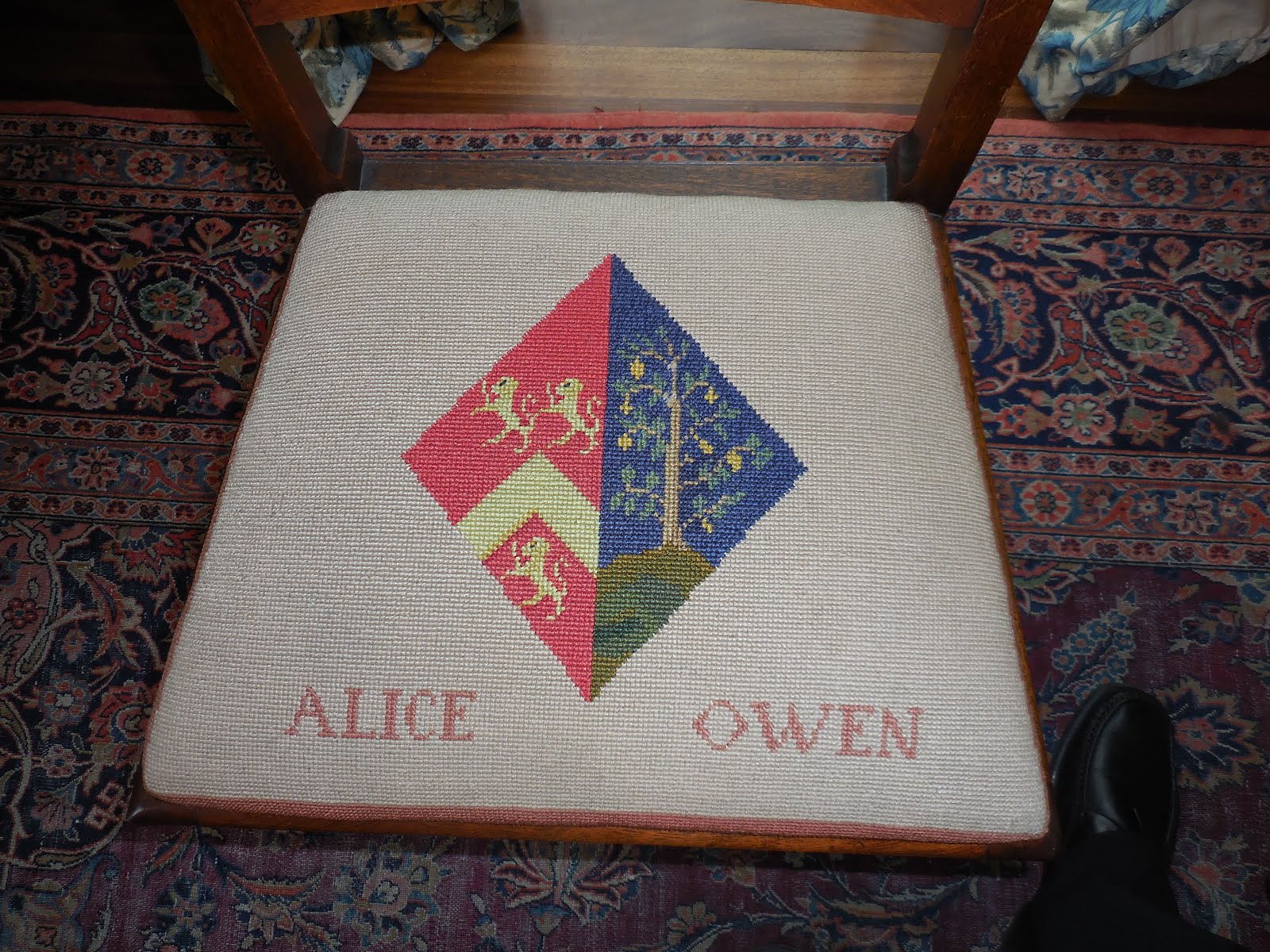
What we have here, as I'm sure you'll have worked out, is "dexter gules a chevron or between three lions rampant of the second; impaling the arms of her father, viz.:- Azure a pomegranate tree eradicated vert fructed or".

Dame Alice Owen was a wealthy widow (which is why her arms are on a lozenge) who outlived three husbands. One of these was a brewer and on her death she left the governing of a school she had established to the Brewers' Company. The school is also still supported by the company, including giving the pupils beer money!

Next we have the arms of James Hickson (1607-1689):


I'm sure it's obvious to all that what we have here is "or two eagles' legs erased a la quise in saltire sable a trefoil vert for difference with a crest issuant out of a ducal coronet or a griffin's head sable beaked of the first charged with a trefoil gold". The motto means "faith and fortitude".

A knight's arms follow, those of Sir Samuel Stirling (decd. 1674).


The shield has the straightforward "argent on a bend azure three square buckles or" with a crest of "hand dexter chucking a shuriken". Ha! Had you there, it's really "from a mount vert a cubit arm erect proper the hand holding an estoile or". Sir Samuel was a former master of the Brewer's Company who left a property (since sold) to it in his will.

I didn't spot the next one but in case you happen to find it in Brewers' Hall it's the arms of Baron Willoughby of Parham (1696-1775) with a simple "or fretty azure". The crest is a bit more involved though, being "a Saracen's head affrontee couped at the shoulders proper ducally crowned or". Henry Willoughby was another master of the Brewer's Company.

The motto is "truth without fear", which reminds me of someone from my Thai boxing club who had a proper mid-life crisis when he hit 40. He got "truth" tattooed on one arm, "courage" on the other, told his boss to stick his job up his arse, and left his wife. The last I heard he'd met someone new and had a kid so I guess it worked out OK for him.


I didn't spot the next one either. Whether it's not in the current Brewers' Hall or I just missed it I couldn't say but just in case here's the arms of Baron Hawley of Donamore (1719-1790):

Those of you that have been paying attention will I'm sure be thinking "ah, engrailed lines again" with the shield showing "vert a saltire engrailed argent" and the crest is "an Indian goat's head couped holding a three-leaved sprig of holly all proper". How they can tell that the goat is Indian I don't know. The motto is in French this time and says "follow me". Samuel Hawley was elected master of the Brewers' Company four times. 


I'm old enought to know which family the next coat of arms belongs to...


... because I can remember when Whitbread was a brewery, not a coffee and hotel company. I recognised the arms of Samuel Whitbread: "argent a chevron between three hinds' heads erased gules" with a crest of a hind's head erase gules. The motto says "virtue is not simple".

Samuel Whitbread also left property to the Brewers' Company.

Lastly there's arms connected to another brewery I can remember:


These belong to Harry Charrington and are "gules a gryphon's head erased between two crosses patee in pale or two flaunches vaire azure and of the second" with the crest "on a wreath of the colours a demi-gryphon gules gorged with a collar gemelle charged on the shoulder with two annulets interlaced and resting the sinister claw on a cross patee all or and holding in the dexter claw a branch of thorn-tree proper".  Sadly the motto isn't about black currents, which surely would have put Charrington's well ahead of their time in terms of beer flavour, instead it reads: "virtue is the safest helmet". Harry Charrington left money to the Brewers' Company.

Charrington's IPA was the first IPA I ever drank. It was brown, sweet and 3.9% ABV, part of the authentic century old tradition of weak, lightly hopped IPAs quite unlike the strong and hoppy modern interpretations seen nowadays.

As well as the arms on the walls there were also some embroidered seats, and this time they handily put the name by the arms:


We've already had Richard Platt.


Sydney O Neville ended up as a big cheese at Whitbread, and I've written about him here. At one point he was the master of the Brewers' Company. His portrait can also be seen in Brewers' Hall:


Next was this:


John Mann I assume of the Mann's brewery fame.


I don't know anything about John Martineau, but it appears he was found dead in a yeast trough.


Alice Owne we've already had.


The Institute of Brewing basically adapted the Brewers' Company arms for their own. The relatively young age of the Institute doesn't stop it getting a coat of arms as this sort of thing still goes on today. As indeed does making new livery companies, the Worshipful Companies of Management Consultants, International Bankers and Tax Advisers being recent additions.


And finally here's in full the rug with the arms of the Brewers' Company and the schools it supports:


* Heraldry and Brewers' Hall, W.H. Bird. Journal of the Institute of Brewing, December 1937.