Tuesday, 3 April 2018

Brewing water and liquor treatments

My dedication to blogging is such that I've failed to write up a talk I gave on brewing water at the SIBA conference years back up until now. But with Boak and Bailey reviving #beerylongreads I figured it was time to pull my finger out.

I was given the title "Aspects of Water Quality" and asked to cover far more than I had time to.


So I quickly rattled through the first bit and focused on ions in water and liquor treatment. 


I'd co-authored some papers on brewing water and liquor treatments for Brewers of Europe so was quite clued up on the subject. 

You can also add sodium metabisulphite

I'm not entirely certain what they did with them as I never saw the final copy, but I did once meet someone from Spain who'd read them so I guess they're out there somewhere.


  • Brewing water: the ingredient, needs treating. 
  • Process water: washing, sterilizing, pasteurisation refrigeration. Should be potable and softened. 
  • General purpose water: Washing down and office use. Should need no further treatment. 
  • Service water, boiler feed. Should be softened and ideally demineralised. 

Now to get to the meat of the matter. First you need to get your water analysed in a laboratory for mineral ion content. You can an analysis on the website of your water company nowadays, but water supplies can change so it's still best to get your own analysis. I know Murphys, who supply liquor treatments will do a free annual analysis for their customers. 


You can do some analysis easily yourself, tasting and looking at the water before using it. Measuring the pH isn't of much use for telling you how to treat your water, but a change might alert you to the fact the water company has switched to a different supply. There are kits you can use to do your own testing, which you can get from supply companies or even from aquarium shops. 


Back before people had learnt how to adjust water chemistry different places became known for doing different types of beer their water was best for: Burton-upon-Trent for pale ales, London and Dublin for porters and stouts, Munich for dark lagers and Pilsen for pale lagers.  

mg/l is the same as ppm for those of you watching in black and white

The different mineral compositions in the water affects the pH of the mash, as does the grist composition with roasted grains lowering the pH. If brewing liquor comes from the brewery's own source it will need to treated to bring it up to drinking water standard. 


Now lets start looking at the chemistry and I must warn you maths will follow. For those of you that are starting to get scared at this point smiley faces and frowns will be used to highlight the good and the bad points.


As bicarbonate is generally bad for brewing it is likely it will need removal and there are several ways this can be carried out.

Temporary hardness that is

Reverse osmosis and deionisation require expensive kit. The most common method used in small breweries is to add acid, represented by the 2 H+ ions in the lower equation. They react with the calcium bicarbonate, Ca(HCO3)2, making water, H2O, and carbon dioxide, CO2.


It's also common to add mineral salts (to the grist rather than the water) to get the calcium level up. Calcium sulphate (gypsum) and calcium chloride are the most commonly used.


Calcium has a number of beneficial effects, the only real negative is that as it lowers mash pH it decreases hop utilisation:

Magnesium, like calcium, will reduce wort pH but it is only half as effective. 


Table salt (sodium chloride) is included in some liquor treatments, but I suspect mainly as a cheap way of increasing the chloride concentration. 
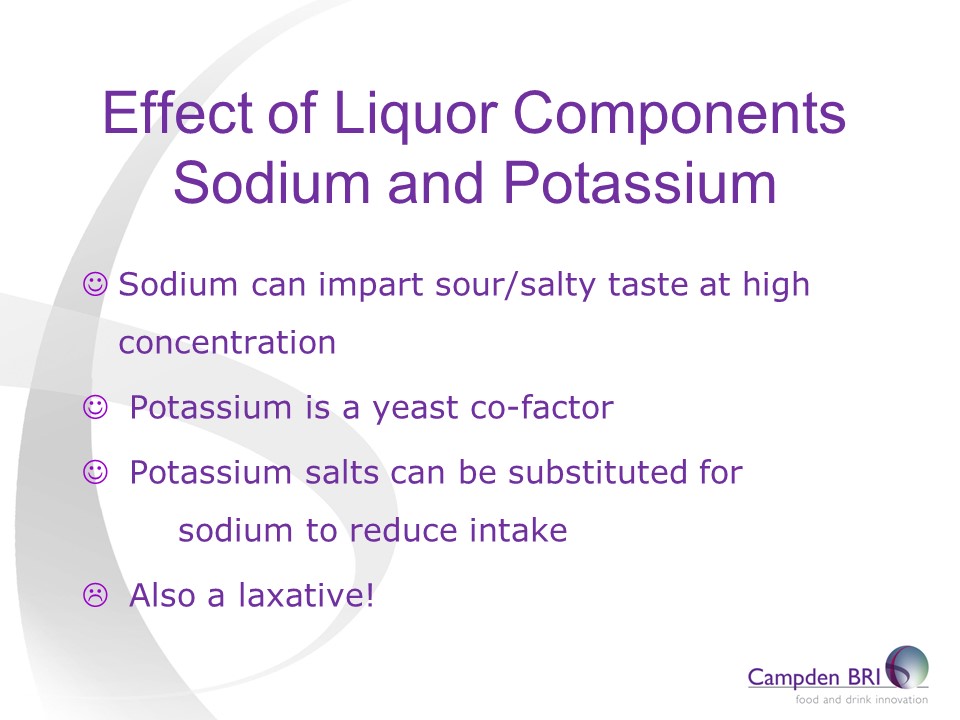


The balance of sulphate and chloride ions is considered important due to the effects it has on beer flavour. 


Though the research I found on it suggests the effects may not be huge:


Generally zinc is the only element that wort may need supplementing with. 


The anions (negatively charged ions) listed here get frowns across the board:


And now to the maths. It is possible to do some calculations to work out how many grams of mineral salts you need to add to get the desired ionic concentration in wort. Calcium sulphate will also contain some water which needs to be factored into the calculations.

Having calculated how much calcium sulphate we need to add to get the desired calcium concentration we then see how much sulphate this adds:


Similar calculations can be carried out for calcium chloride. There are also calculators online that can do this sort of thing for you. 

A useful way of looking to what liquor treatment brewing water will require is to calculate the Residual Alkalinity. By working out how much the calcium and magnesium present in the water will break down the bicarbonate it is possible to determine the Residual Alkalinity that may require further treatment. 


A multi-national company I brewed for whilst I was at Campden BRI went for very simple liquor treatment for all beers: use Reverse Osmosis water and add gypsum to the mash to give 100 ppm of calcium.

The basic requirements for brewing liquor ion composition have been summarised quite simply:

Sulphate/chloride ratio to taste!
A more sophisticated view of suggests the following Residual Alkalinity (CaCO3 mg/l) for different beer styles:
Pilsner: -35 to 35
Light beer: less than 90
Dark beer: less than 180

There is information out there. The water book is over long and rather dry* but does contain a lot of information. I wouldn't recommend reading it cover to cover, just look up the chapters you need. 

The Handbook of Brewing contains a good chapter on water, and is now up to its third edition. 

Supplies of liquor treatment are of course also a good source of information on the subject, unlike the SIBA technical helpline which had the plug pulled on it. 


*Yes, I even managed to work a joke into a talk on brewing water. Not a great one I'll admit, but you can only work with the material you've got.

Sunday, 1 April 2018

Pre-wedding pub crawl in London

Apparently you're not allowed to have stag dos anymore. It seems that nowadays husbands to be aren't keen on ritual humiliation. So I'll just say I recently found myself going out for some pre-wedding drinks with friends.

We set off from Waterloo and passed some mysterious boats whilst heading north of the river


What's going on there I've no idea but I bet it makes them ill.

Our first stop was meant to be the Lyceum Tavern.


Sadly the staff were enjoying conjugal relations with close relatives so it wasn't bleedin' open. Fortunately our next stop was.


The Coach and Horses must have been a Watney's pub at some point.


Which reminds me of the joke about the innocent lad visiting London for the first time. He calls his dad from the payphone in the corner of the room and say's it's all going really well. He's found a building with a red light outside with lots of friendly people in it. "Get out of there" his dad shouts back, "that's a Watney's house!".


No Watney's for us though, but the fact the groom didn't even finish his first pint was an indicator of how things went. Poltroonery and senile lightweightism meant we were all on to halves depressingly early.


An innovation in pub crawling was the detour to a hat shop. It was certainly different but I'm not sure it will catch on.


The next pub was surprisingly named after the classic Dumpy's Rusty Nuts instrumental Crosskeys.


I must say I fully approve of this and we even did a little jig outside in the traditional manner.


The beers were from Greene King and Brodies, and perhaps more importantly the crisps were from Tayto.


It was a Sam Smith's pub next so no chance of more Taytos there.


The beer was getting to the bottom of the barrel too, so my mates had some pretty rough beer.


But fear not, I'd got the first pint and mine was fine. The Flying Horse followed, where again the beer wasn't great.


Nice malt and hops table downstairs though.


Then it was The Fitzroy, another Sam Smith's pub. Given the experience in the previous one it was declared that keg beer was an acceptable choice.


The lager came in a very thin glass as you can't see in this photo:


There was also a breakthrough in finding non-own label products:


With the angostura bitters the count is now up to three. On the way to our next pub we were tempted to go off piste by a dodgy George Orwell plaque.


Good job too, as not only was The Wheatsheaf a cracking pub...


...it had Landlord and Exmoor Gold on on. I had a pint in this one, I can't resist Landlord.


The Dog and Duck followed.


I think I had a beer called "Dave" in this one.


And guess who used to drink here?


It was getting a bit like Krays pubs in the East End. I guess Orwell drank in a lot of pubs in central London. Another Coach and Horses was our next stop.


I was a bit suspicious of the trough at the bottom of the bar in here. I wonder if it was originally for gobbing in?


Nice pub though, and more pleasantly they had four types of picked eggs. I was also far enough gone to buy one.


This is the beetroot one:


Didn't taste of beetroot, or vinegar either, which counts in its favour if you ask me.

Our next stop was for its historical significance, as they don't serve pints or real ale in the French House. We were scoring the pubs using the Scientific Scoring System and I had to save one of my friends from straying from ecumenicalism into outright heresy when he tried to give it a point for beer quality as "his Guinness was nice".


It was back to beer as god intended at the Lyric, though the pub only scored a lowly three out of ten.


As did the Queens Head, but we were definitely flagging by this point.

The Conquest of Bread

We made a last stop at The Harp and then it was time to pour ourselves home.


The Scientific Scoring System was used throughout the pub crawl.


We determined that the Dog and Duck was the best pub. Subjectively I'd preferred The Wheatsheaf, which really shows the importance of rigorous scientific analysis so pub quality can be objectively determined.


Saturday, 24 March 2018

A visit to gin lane

Yesterday had a rare departure from Beer Street and Visited Gin LaneSipsmith gin mind, so posh stuff, though it must be said it didn't look posh from the outside.


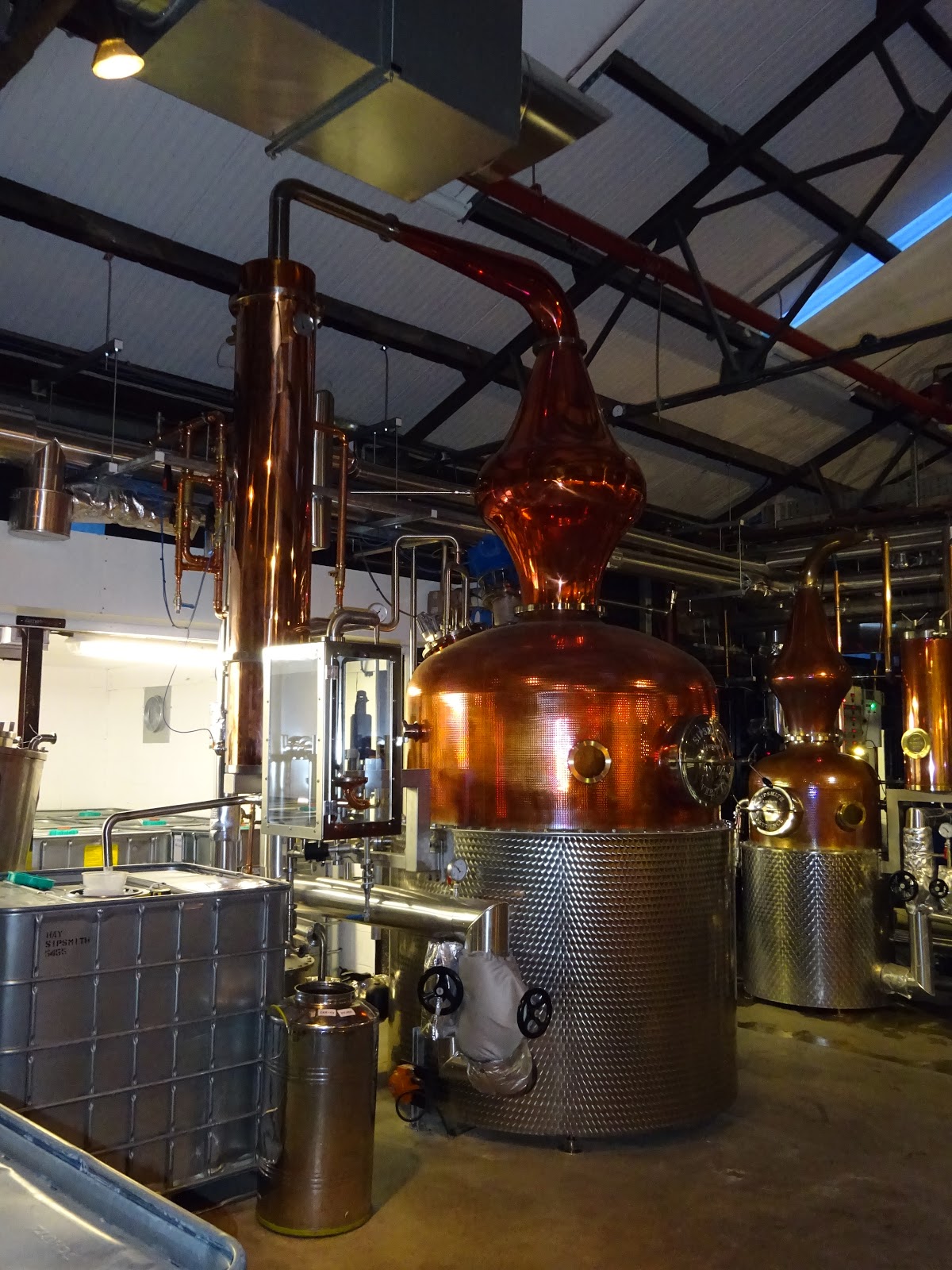
There's plenty of gleaming copper inside though. Copper is important in distillation as it removes sulphur character.


Gin distillers generally buy in alcohol at 96% ABV and re-distil it with botanicals give it flavour. Which has always sounded like cheating to me but it was interesting to hear that the base spirit does give some character to the gin. A Sipsmith they use a wheat based spirit which gives some vanilla flavour, grape bases ones are more fruity and molasses give spice.


The base spirit is diluted to 40-60% ABV before distillation with the botanicals. Sipsmith are at the high end starting the distillation at 60% ABV.

The rectifier for the vodka they make
They use ten botanicals. Juniper legally has to be the predominant flavour in gin and it also adds pine and resin notes. Coriander is the next most important and gives citrus, lemon/lemon grass flavour to the gin and Angelica root is the third most important giving a dry floral flavour like parma violets without the sugar. Orris root is said to act as a fixative for flavours and is high in polyphenols. Liquorice adds sweetness and cassia gives aniseed. Cinnamon comes over quite subtlety after distillation, almond adds mouthfeel and lemon peel is, well, lemon.

Almond not on display in case anyone is allergic to nuts

They boil at 80°C and the vapour passes through narrow pipes in the neck of the still into the helmet at the top where it expands which promotes reflux.


The light vapour that escapes the still goes over the swan neck and is condensed. Despite starting with a 96% pure spirit base the heads are still high in methanol and acetone so are no used. The heart is used for the gin and will come off the still over five hours. The tails have poor character and are not used either. They are high in isopropanol but most of the poor character is due to vegetable (parsnip) character and fatty acids from the botanicals. 


At Sipsmith the heads are approximately 5% of the distillation, heart 80% and tails 15%. Some distilleries will re-distil the first part of the tails but they send all the heads and tails away. The cuts can be decided on ABV (heart 80-70% ABV), volume, flavour (nose), bubble size in still (it changes during the distillation) and temperature of vapour (83-87°C). 


They cut the heart with de-mineralised water to 41.6% ABV to make their "one shot" London dry gin.  


There are also concentrated gins made with 20-30 times as much botanicals which will be cut with alcohol and water to make the gin, distilled gins where some of the botanicals are distilled separately and compounded gins where the base spirit is simply flavoured without distillation.

We had a taste to three different cuts from the heart of the distillation and they were noticeably different. Hydrophobic compounds will to some extent go over the still earlier than their boiling point would suggest, sweetness and glycerine come over more in the third hour.


If peppercorns are used as a botanical the flavour comes over really late so  they don't work well with fruit which comes over early.  


It was an interesting visit, and the first time I've drunk gin in a long while.


It still tastes better with tonic in it though.

Monday, 19 March 2018

Finally a decent advent calendar

Back when I were a lad we had an advent calendar. We used the same one each year, it was made of layers of card with numbered doors on the front about the size of postage stamps. When the right day arrived the door would be opened to reveal a picture. It was not massively thrilling, but Christmas drawing closer was so I suppose it added to the excitement in a small way. After Christmas the doors would be folded back and it would be put away for next year.

Nowadays you can get advent calendars with toys, chocolate and booze behind the doors. Not the sort of thing I'd actually spend any money on but when I was offered a free beery one there could only be one answer.

As I usually do I enjoyed drinking the free beer. Particularly as since I finally found some German beer I really enjoyed I've been keen to learn more about the fourth ranked Great Beer Nation. This selection provided a great overview of German, and quite possibly Austrian, beers: pale lagers, dark lagers, wheat beers, bocks, dopplebocks and even a pale ale. Though as I don't know a much about German beer I can't really rate how respected the breweries are. Except for Salvator which I was very pleased to see as I'd even considered buying some shortly before the box arrived.


There's also a ludicrously thin beer glass that you won't be able to wash up unless you have a dishwasher but more importantly the Germans seem to be big on re-using bottles. So they're all thick bottles with easily removable labels are a welcome addition to my homebrew stock. And one of the bottles even came with a Santa hat:


Admittedly it's not quite as exciting as a pump clip with a flashing LED but it still amused me, cheers Kalea!


Wednesday, 14 March 2018

Greene King's Heritage Beers

I can't think when I've last put as much effort into finding beer as I did with Greene King's heritage beers. Three bleedin' trips it took me before I found them and even then it was only because I saw on twitter they had been reduced to clear that I wandered away from the beer section and found them in another display.


Still, on the plus side they were reduced to £1.87, which seemed very reasonable, particularly as the strong one is 6.5% ABV. It was in fact the pints bottles that caused my, and Tesco's, difficulties. They're made to a historic bottle design and so of thicker glass. The cardboard trays the bottles come in couldn't cope with the weight so the bottles were insecure. Tesco's response was to try and shift them as quickly as possible by giving them a massive display and a cut price.

Two beers "inspired" by records from the 1800s have been produced in the heritage range, both made using pale malt made from Chevallier barley. Chevallier is a land race barley that once the most popular variety in Britain. The Suffolk Pale Ale at 5% ABV also uses land race hops: Saaz and Strisselspalt. The stronger beer went a little off piste as one of the hops used (Bramling Cross) comes from Wye College breeding programme that started in the 20th century.

I didn't get upset by this though, as unlike some brewers that wander they didn't claim to be following a specific recipe, and I was keen to try beers made with Chevallier. The beers taste great too, the historic inspiration certainly made them crank the hops up from what's normally found in Greene King beers. More beers are planned for the heritage range and I look forward to seeing what comes next.