Tuesday, 20 July 2010

The boil

After a spate of problems struck brewing bloggers I dug out some of my revision notes from when I was a brewing student to remind myself exactly what the boil does during the brewing process. Soon after I'd read them a wine maker visited the brewery I work at and asked if we boiled the wort to sterilise it. As I'd freshly read up on it he got more than he bargained for."Oh no, it's much more than that" I said and taking a deep breath I burbled on until I saw his eyes start to glaze over.  

Here's the notes for those of you that are interested. There are a few things that confuse even me though. Why is there a question mark after saying the optimum pH for trub formation is 5.2? And what exactly did I mean by saying a wedge disrupts bacterial cell walls at low pH? I may have to investigate further...


Briefly descirbe the various processes that occur during wort boiling:

 Extraction and transformation of hop compounds – extracts bitterness, aroma and limited antibacterial activity.
 Formation of protein-polyphenol complexes 
 Wort sterilisation
 Destruction of enzymic activity
 Increase in colour – maillard reactions
 Decrease in pH
 Production and removal of unwanted flavour compound (sulphur compound)
 Concentration – evaporation of water and volatiles.

Wort boiling aims to facilitate:

Flavour, aroma and colour development
Stabilisation (physical and biological)
Concentration

 Extraction and transformation of hop compounds – extracts bitterness, aroma and limited antibacterial activity.

- Alpha acids are essentially insoluble in wort but are isomerised during the boil to iso-α-acids (approx. 30-35% efficiency, less in high gravity brews). The iso-α-acids have the bittering and antibacterial properties. A long boil increases utilization but drives off aromas. Humulones are converted to cis and trans iso-humulones.
- Hop oils are also extracted but are very volatile so need to be added late or specific aroma oils towards the end of the boil.
- Hop polyphenols are also extracted and play an essential role in break formation, also give some limited bitterness.

 Formation of polyphenol complexes

- Polyphenols come from the hops and the malt
- Malt polyphenols appear to be more actively involved in trub formation.
- Protein-polyphenol complexes form due to interaction between negatively charged proteins and positively charged polyphenols.
- Heat increases this reaction and causes co-precipitation of the proteins and polyphenols due to the coagulation of the proteins. The longer and more vigorous the boil the more mixing and precipitation.
- This complexes form the hot break, cold break on chilling and chill hazes later on.
- Trub can be removed in a whirlpool, centrifuge or hop back.
Optimal pH for trub formation is 5.2 (?)

 Wort sterilisation.
- Heat kills all living organisms in the wort.

 Destruction of enzymic activity.
- Heat denatures all the enzymes and stabilises the protein and carbohydrate profile of the wort.

 Increase in colour – maillard reactions
- Wort becomes darker due to oxidation of polyphenols and production of melanoidins.
- Melanoidins are formed by the reaction between amine groups in amino acids and carbonyl groups in sugars.

 Decrease in pH
- This is mainly due to the production of melanoidins.
- Lower pH helps trub precipitation, increases wort colour, give better and cleaner hop bitterness, decreases hop utilisation and helps inhibit bacteria as low pH causes intracellular pH to drop and the cell wall is disrupted by a wedge causing leakage.

 Production and removal of unwanted flavour compound (sulphur compounds)
- DMS produced but also evaporated by the high temperature. The precursor is SMM from barley which converts to DMS on heating.
- DMS can end up in beer if there is poor whirlpooling, too high fermentation temperature (so SMM is still being converted into DMS) or too low fermentation temperature so not enough DMS is driven off. Or bacterial contamination.
- SMM from the barley can be converted by kilning and boiling to DMSO which will survive through to the fermentation at which point the yeast will convert it to DMS but a vigorous fermentation will drive it off. Too hot and too much SMM to DMSO though, too low and not enough DMS driven off.

 Concentration – evaporation of water and volatiles.
- Want minimum of 7% boil off per hour. Good rolling boil for trub formation and driving off of volatiles. High pressure boiling will save time and energy but produce off flavours and hazes as the volatiles are not driven off.

Sunday, 18 July 2010

White Shield is moving again

Battered old warhorse Worthington's White Shield is moving to a new brewery again. Once one of the few remaining bottled conditioned beers in Britain, Brewer and Distiller International reports that it fell from selling 25,000 barrels pa to just 400 when it was brewed under contract by King and Barnes (which is also where it went a bit rubbish). Current owners of the brand Coors have been investing in it and "it is now thriving to such an extent that it is being taken back to the 'big' brewery, where the staff are delighted". Let's hope the flavour improves with this move, it used to be good stuff.

Saturday, 17 July 2010

Tonbridge beer festival


I called in briefly at Tonbridge beer festival yesterday. Though organised by SIBA it had much the look of a CAMRA festival, except the glasses weren't oversized. Probably just as well as I was driving. 

It was pretty empty, but then we did get there early in order to hear the competition results being announced. I bumped into the Munton's sales rep who'd been involved in the judging and had a gossip with him. We didn't win anything though, so it looks like a change of malt supplier will be in order...

Wednesday, 14 July 2010

Strange Dogfish head beers

When I was buying a crap Brazilian lager for the World Cup beer sweepstake I made sure I got some stuff I was actually wanted to drink too.

The beers from Dogfish head brewery in Delaware have interested me ever since I bought their 22% ABV World Wide Stout back in the days when Safeways was my local specialist beer shop. As I have relatives in Delaware I've been giving my mum a shopping list when she goes to visit but sadly for me she insists on bringing the clothes she's packed back with her so there's not much room for beer. 

As I'd got a tip off from a blog comment that Dogfish head beers could once again be bought in Britain they were the first things I added to my online shopping basket once I'd got the required Brazilian gnats piss. 

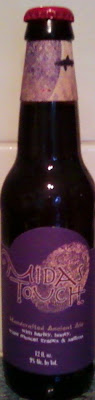
My first choice was Midas Touch, a beer based on analysis of the residue of a 2700 year old drinking vessel. I have a fascination with old beers. I've brewed a few based on recipes in Old British Beers and How To Make Them and the blogs that tend towards the historical, like those of Ron Pattison and Martyn Cornell are some of my favourites. 

Despite the wide range of beers that can now be bought some of the beers that interest me aren't available commercially so at times I have a go at 'brewing beers like those you can't buy' . Some of my efforts in this direction have been brewing unhopped ales. The blurb about Midas Touch suggested it was unhopped:

This recipe is the actual oldest-known fermented beverage in the world! It is an ancient Turkish recipe using the original ingredients from the 2700 year old drinking vessels discovered in the tomb of King Midas. Somewhere between wine & mead; this smooth, sweet, yet dry ale will please the Chardonnay of beer drinker alike.

The taste did remind me of my own attempts at ales, though more complex. It manages to be sweet and dry at the same time and almost like a fizzy wine. On the website it says that Midas Touch as 12 IBUs so there must be a small amount of hops added. It's certainly an interesting drink, but I won't be rushing out to buy it again. 

Next up was Palo Santo Marron, a beer aged in vats made from an exotic South American tree. Surprisingly it was quite mild in taste (at least as far as strong wood aged beers go) and went down rather easily. I enjoyed this one more, but not enough to fork out a fiver for a 355ml bottle again anytime soon.


So there you have it, I'm glad I drank them but having done that I'll save my money for cheaper stuff in future. 

Monday, 5 July 2010

Damned if you do and damned if you don't

The anti-alcohol lobby opened a new front this morning: 'think of the children'. On the radio they had some raving alkie talking about how bad she was at one point (up to four bottles of scotch a day) intercut with tiny Tim or whatever her offspring was called saying how bad he thought it was. 

This was then followed by Wetherspoons boss Tim Martin and some anti-alcohol bloke discussing how booze is too cheap in supermarkets. 

The BBC website also had an article about some children feeling scared when they see adults drinking too much: 'Childwise research director Rosemary Duff said the 30% who felt scared when adults drank was a "sizeable minority".

But she said it was also a concern that nearly half of children were "not bothered" by drunkenness, which, she said, suggested drinking culture had become "ingrained".'

So there you have it, drinking alcohol is bad because it scares children. Unless it doesn't scare them, in which case it's also bad.

I wish these sanctimonious killjoys would just bog off and leave us to get pissed in peace. 

Sunday, 4 July 2010

We have it in our power to build the world anew

As it's the forth of July I put on my Tom Paine T Shirt and raised at toast to him. Sadly I didn't have any Harvey's Tom Paine to drink but a bottle of Goose Island IPA was a good consolation.  

I spent a very enjoyable afternoon drinking in the sun with the lovely Lisa and our friend Dan. The trouble is with afternoon drinking what do you do in the evening? Though not ideal for a Sunday there was no escaping the obvious answer: drink some more. Just a small nightcap though, there's beer to be made tomorrow. 

Thursday, 1 July 2010